webAI put TwIL-8B on Hugging Face on November 4 and the model runs well on a Mac. Two routes are confirmed. The official route is a 4.98 GiB Q4_K_M GGUF through llama.cpp. The other is a community 4-bit MLX conversion for mlx-lm on Apple silicon. Both sit at about 5 GB of weights. One constraint to read first: the model is licensed for non-commercial use only. If you already keep a local model running with Ollama, this is the same kind of setup, just a different loader.
What webAI shipped with TwIL-8B
TwIL-8B is 8.79B parameters (8,791,592,960 exactly), post-trained from IBM's Granite 4.2 8B with full-parameter supervised fine-tuning and GRPO/DAPO reinforcement learning. It comes in two variants that share one architecture and tokenizer. balanced, the default, keeps reasoning traces shorter. verbose, in the verbose/ folder, thinks longer for hard contest problems. The context window is 131,072 tokens.
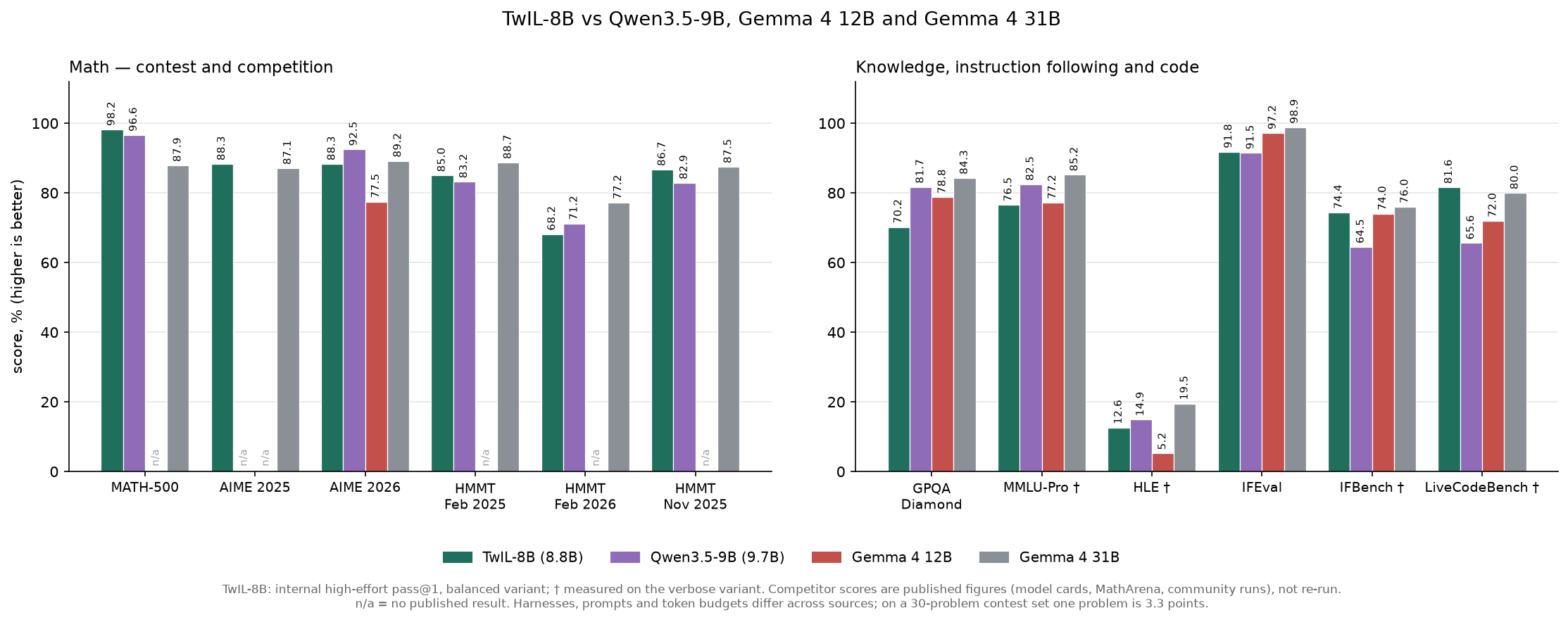
The published scores are math and code heavy. MATH-500 is 98.2 and LiveCodeBench is 81.6, both best in webAI's size comparison. Knowledge is the weak side. GPQA Diamond lands at 70.2, below Qwen3.5-9B at 81.7 and Gemma 4 31B at 84.3. webAI measured all of these on the bf16 weights, so expect small deviations on the GGUF and MLX builds.
Run the official GGUF with llama.cpp
Pull one file, TwIL-8B-Q4_K_M-balanced.gguf, then run the command from the model card:
llama-cli -hf webAI-Official/TwIL-8B --hf-file TwIL-8B-Q4_K_M-balanced.gguf -cnv -c 40960 -n 32768
The --hf-file flag is required. Each quant exists for both variants, so the loader needs the exact name. Keep -c and -n large. The chat template opens a thinking block by default and the model reasons before it answers. On contest math, balanced averages about 19.5k output tokens per AIME 2026 problem. A short budget cuts the trace mid-thought and scores drop. The shipped generation config samples at temperature 1.0 and top_p 0.95.
The Q4_K_M build is 4.98 GiB. For more headroom, verbose also ships as Q8_0 (8.70 GiB) and F16 (16.38 GiB). On Apple silicon, llama.cpp uses Metal, so this runs the same on M-series Macs. In our Ollama MLX tag walkthrough, the MLX side of that stack is covered separately.
The community MLX 4-bit path on Apple silicon
pratikgx published an unofficial 4-bit MLX conversion at pratikgx/TwIL-8B-MLX-4bit. It converts the balanced variant (revision 58d49f0d) at 4.50 bits per weight, about 4.95 GB in one safetensors file. The stock mlx_lm.convert -q keeps some Granite layers at 8-bit. This build forces every quantizable layer to 4-bit. It is not made or endorsed by webAI.
pip install mlx-lm
mlx_lm.generate --model pratikgx/TwIL-8B-MLX-4bit --prompt "What is the sum of the first 50 odd numbers?" --max-tokens 2048
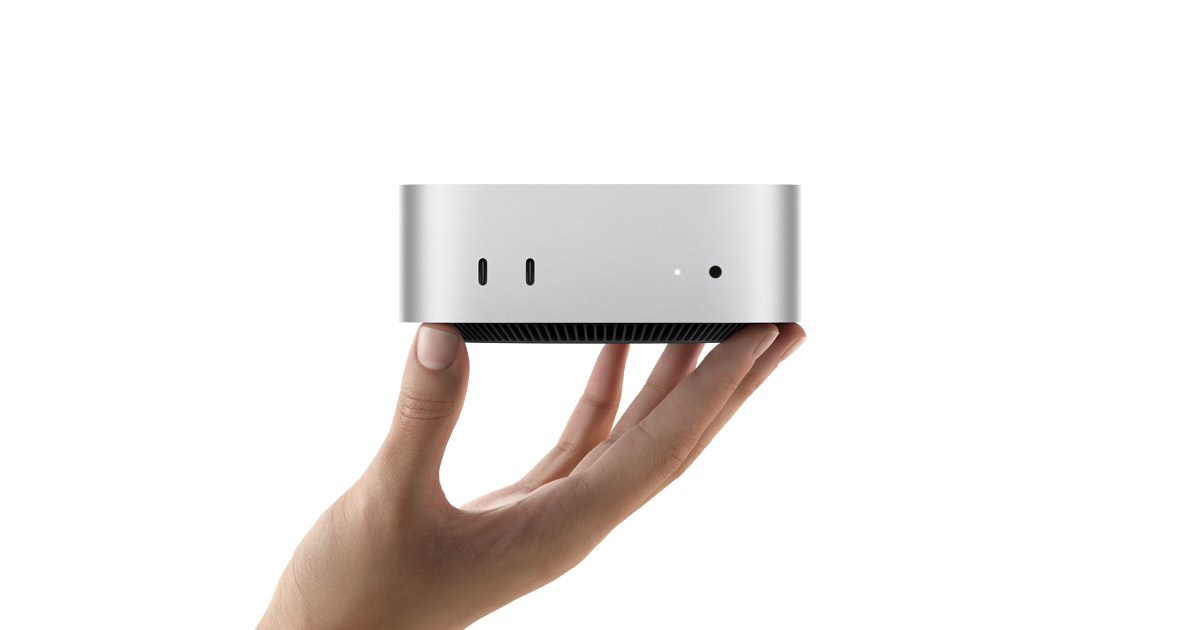
Speed figures come from pratikg's own tests on a 64GB M5 Pro Mac mini (macOS 27.0.1, mlx 0.32.4), not from this site. At 512 context, generation ran about 53.76 tokens/s with 5.57 GB peak memory. At the full 131,072 context it fell to 9.16 tokens/s and 27.85 GB peak. The author notes the long-context runs were noisy. Commands and logs are in the bench dataset.
The license and the limits
TwIL-8B ships under the webAI Non-Commercial License ver. 1.0. Non-commercial research and education are allowed. A commercial product is not. The Granite 4.2 8B base stays under IBM's Apache 2.0 terms and credit goes to IBM.
Two more limits from the model card. There is no safety or preference tuning beyond what Granite 4.2 carries, so this is not a general assistant. And enable_thinking=False or reasoning_effort=low will lower latency, but webAI says scores drop and none of its published numbers use them.
For a graphical loader, LM Studio imports Hugging Face GGUF files. Search for webAI-Official/TwIL-8B and pick TwIL-8B-Q4_K_M-balanced.gguf. Our LM Studio Apple silicon guide covers the app side. To hold any local model in memory across sessions, the Ollama keep_alive tip still applies.
Start with balanced. Move to verbose only when a problem needs it. Read the license before you ship anything built on it.
Photo: Hugging Face / webAI-Official, Apple, pratikgx
Source: webAI TwIL-8B model card, pratikgx TwIL-8B-MLX-4bit