Micron reported fiscal fourth-quarter 2026 results on September 30. The quarter ended September 3. Total revenue was $54.23 billion, against $41.46 billion the quarter before and $11.32 billion a year earlier.
The part phone makers watch is the Mobile and Client Business Unit, or MCBU. It sells the LPDDR and NAND that go into smartphones and PCs. That unit set a record. Micron says the gain came from price, not volume.
Mobile and Client unit at $13.1 billion
MCBU revenue was $13.114 billion in the quarter. It was $11.521 billion in fiscal Q3 and $3.760 billion in the same quarter last year. The unit was 24% of company revenue.
On the earnings call, CFO Mark Murphy said MCBU revenue rose 14% sequentially, "driven by higher pricing partially offset by lower bit shipments." So Micron shipped fewer mobile and client bits than in Q3 and still made more money on them.
Gross margin in the unit was 90%, up 260 basis points on the quarter. A year ago it was 36%. Operating margin was 88%, from 86% in Q3 and 29% a year earlier.

Photo: Apple
1-gamma LPDDR5X in flagship phones
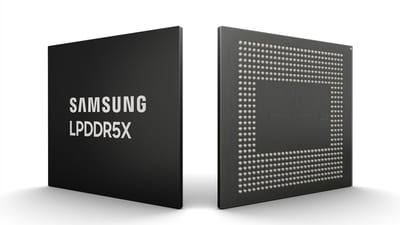
In the product list, Micron says it is now shipping 6-channel 1-gamma LPDDR5X for flagship mobile devices. Nearly half of MCBU revenue in fiscal Q4 came from 1-gamma products, per CEO Sanjay Mehrotra. Customers are speeding up qualification of that node for lower power and higher performance, he said.
Micron has also started sampling 1-gamma LPDDR6. The release lists that sampling for physical AI markets, not phones.
Double-digit unit declines, revenue still up
Mehrotra's view of the device side is short. PC and mobile industry revenue is "on track to grow this calendar year," driven by the premium end. That is "despite potential double-digit overall unit declines in both markets." He said OEMs keep adding AI features to flagship phones and PCs, and those devices carry more DRAM and NAND.
That lines up with outside numbers already on this site. Counterpoint has 2026 phone shipments down about 14.3%, covered in the 2026 smartphone shipment forecast. Samsung also raised U.S. Galaxy S26 prices on October 1, see the Galaxy S26 price hike brief. Fewer phones, but each one carries pricier memory.
Photo: Apple
Supply view for 2027 and 2028
Micron expects memory and storage supply to be "much tighter" in calendar 2027 and 2028 than in 2026.
For DRAM, Micron sees industry bit shipments up in the mid-20s percent range in 2026, then low-20s percent in 2027 and 2028, with the industry supply constrained in both years. For NAND, it sees low-20s percent growth in 2026 and about mid-20s percent in 2027 and 2028, also constrained. HBM bits grow faster than conventional DRAM through 2028, the company said. Mehrotra listed the HBM "trade ratio," and smaller gains per wafer from new nodes, as headwinds to supply growth.
Asked about relief, Mehrotra said Micron does "not see line of sight" to when supply catches up with demand. New clean room space coming in 2028 still ramps slowly, he said.
Guidance for fiscal Q1 2027 is revenue of $61.5 billion, plus or minus $1.5 billion, and non-GAAP gross margin near 86.25%. Customer cash deposits under its strategic customer agreements stood at $12.7 billion at quarter end.
What Micron did not break out
Micron did not split MCBU between smartphones and PCs. It gave no mobile DRAM price per gigabit and no smartphone unit forecast beyond "double-digit" declines. It named no phone customer. Apple came up on the call only in an analyst question about cash balances.
For contract price ranges, the closer read is still TrendForce. Its 4Q26 DRAM contract outlook has conventional DRAM up 10 to 15% on the quarter. Earlier reporting on Apple's Q1 2027 LPDDR5X quote from Samsung put the figure near $2 per gigabit. Micron's own report confirms the direction, not the number.
Photo: Apple
Source: Micron Technology fiscal Q4 2026 press release and earnings call, Sept. 30, 2026