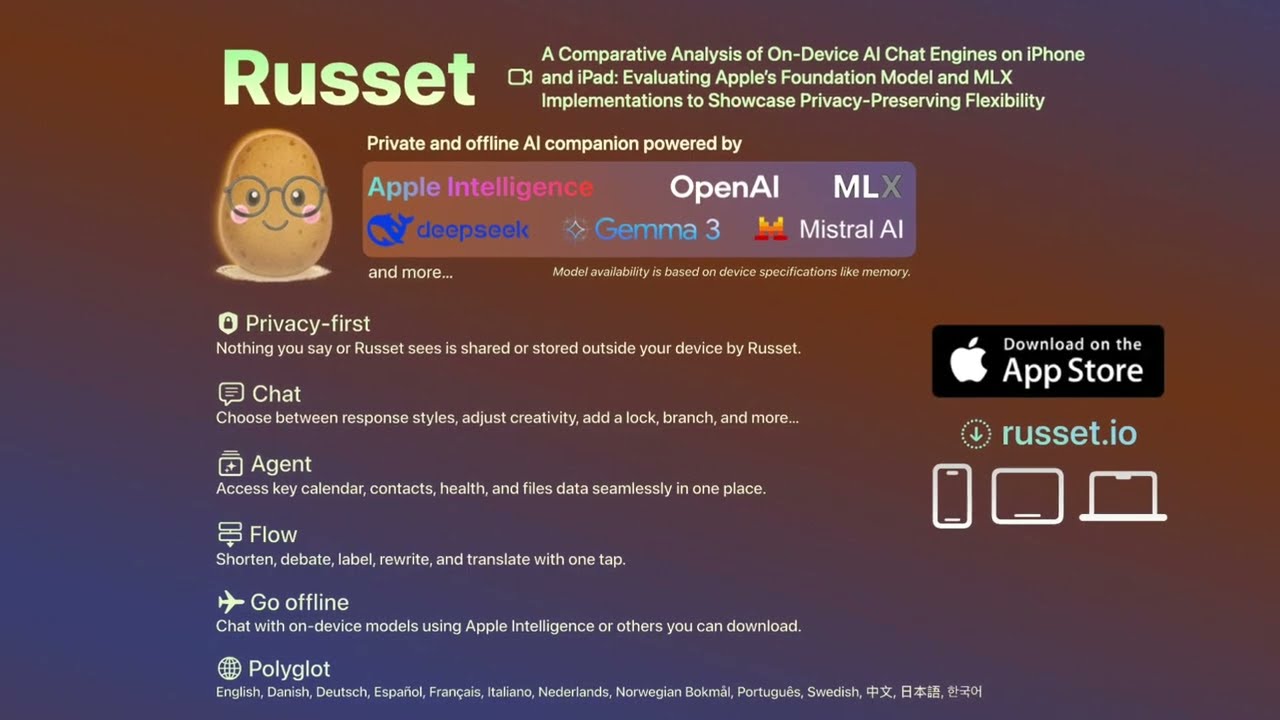
Introducing Russet, an offline, on-device AI companion for iPhone, iPad and Mac. Russet gives users the flexibility to switch between Apple’s Foundation Model and MLX models—Apple’s open‑source framework that runs large language models locally using a unified memory architecture and supports quantization.
Using Xcode Instruments, this video measures CPU, memory and battery impact of different model types, and showing that on‑device AI on Russet is both, energy‑efficient and smart. Specifically, I compared the on-device Apple Foundation Model (https://doi.org/10.48550/arXiv.2407.21075) with mlx-community/gemma-3-1b-it-4bit (https://huggingface.co/mlx-community/gemma-3-1b-it-4bit) which was converted to MLX format from google/gemma-3-1b-it (https://huggingface.co/google/gemma-3-1b-it) using mlx-lm version 0.21.6 on an iPhone 17 Pro running iOS 26.2.1.
If you agree that privacy matters, and should not be compromised for AI, give Russet a try: russet.io
0:00 Introduction
1:39 Measuring Apple Foundation Model Speed on Russet (iOS)
2:21 Measuring MLX Model (Gemma 3 1B) Speed on Russet (iOS)
3:24 Measuring Apple Foundation Model CPU & RAM on Russet (iOS)
4:11 Measuring MLX Model (Gemma 3 1B) CPU & RAM on Russet (iOS)
5:13 Summary
Note: Ricky is the original author of this video, we just embed it, if you have any questions please contact him via Youtube.