Xiaomi officially released a new generation of 3nm flagship mobile processor XRING O3, becoming the world’s first chip to support LPDDR6 memory. The AnTuTu evaluation score exceeded 5.22 million. This chip uses TSMC’s 3nm advanced process, has more than 24 billion built-in transistors, and is deeply optimized for the MiMo terminal AI model. The overall AI performance is 45% higher than the previous generation. XRING O3 is expected to debut next month with the new foldable phone Xiaomi 18 Fold. In addition, the official XRINGO100 accelerator for large language models and the 3nm chip XRING D100 dedicated to intelligent driving were also exhibited at the same venue!
Xiaomi held an XRING chip technology communication meeting today, officially launching a new generation of 3nm flagship mobile processor XRING O3, and announced that this core hardware will be the first to debut with the new folding phone Xiaomi 18 Fold next month. Officials also announced at the meeting that the chip scored a whopping 5,228,014 points in the AnTuTu evaluation, demonstrating its significant upgrade in performance and AI computing.
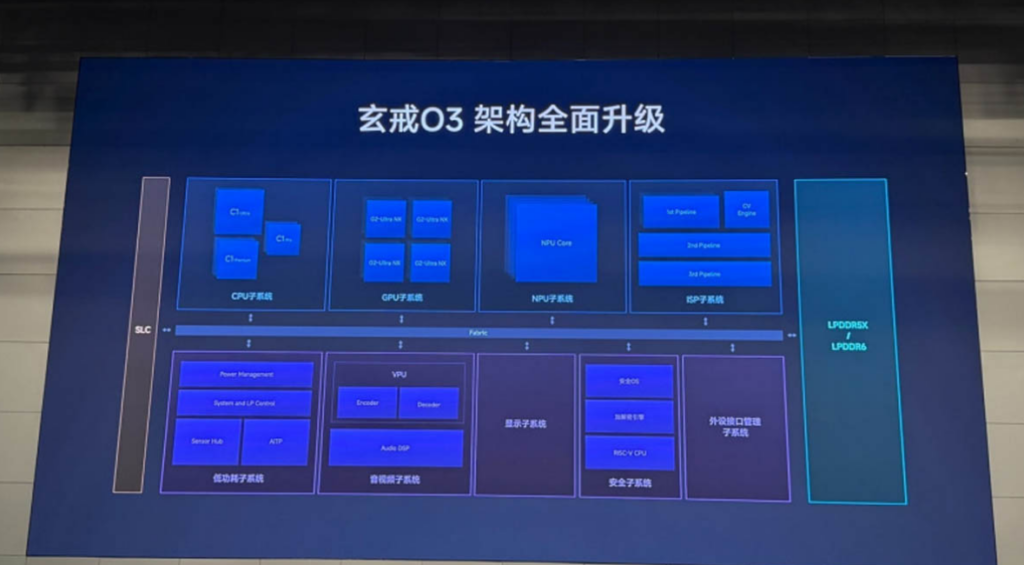
In terms of hardware specifications, XRING O3 uses TSMC’s 3nm advanced process technology, with an overall chip area of 133mm². Through the upgraded chip architecture design, more than 24 billion transistors are packaged inside, a 26% increase compared to the previous generation XRING O2. It is worth noting that XRING O3 is the world’s first mobile processor to support LPDDR6 memory. It can provide memory transfer speeds of up to 10,667Mbps and memory bandwidth of 113.8GB/s. Compared with the previous generation XRING O1, it has brought a 48% bandwidth increase, laying a solid foundation for multi-tasking and high-load environments.
In order to cater to the sharply growing demand for device-side computing in recent years, Xiaomi has completely redesigned the internal architecture of this chip, especially in-depth optimization of its own MiMo terminal AI model. The tensor operation performance of XRING O3 can reach up to 200 TOPS, while the vector operation performance is 3.13 TFLOPS. The overall AI performance has been significantly improved by 45% compared to the previous generation. In addition, the chip has two built-in CPU AI acceleration units and eight neural network GPU accelerators, further expanding the device’s deep learning and data processing capabilities. Officials also pointed out that through targeted adjustments to the internal architecture, the new generation of chips has improved energy efficiency and response speed, and effectively reduced system latency to 82ns.
In addition to the XRING O3 dedicated to smartphones, Xiaomi also announced two new AI chips targeting different fields. One of them is the AI accelerator XRINGO100, which is specially designed for large language models. This product adopts 6nm 3D wafer-level advanced stacking packaging design for the first time, with a bandwidth of up to 1.22TB/s, aiming to improve the throughput efficiency of huge amounts of data. The other is a 3nm high-computing power AI chip named XRING D100. As the first hardware core developed specifically for intelligent driving systems in China, it fully demonstrates the brand’s technical layout in the cross-platform smart ecosystem.