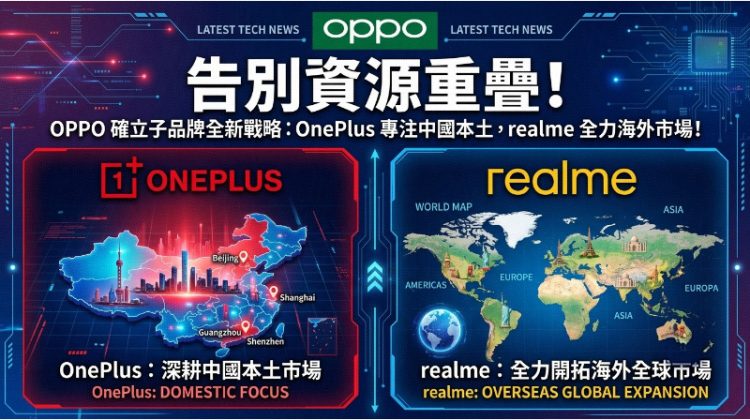
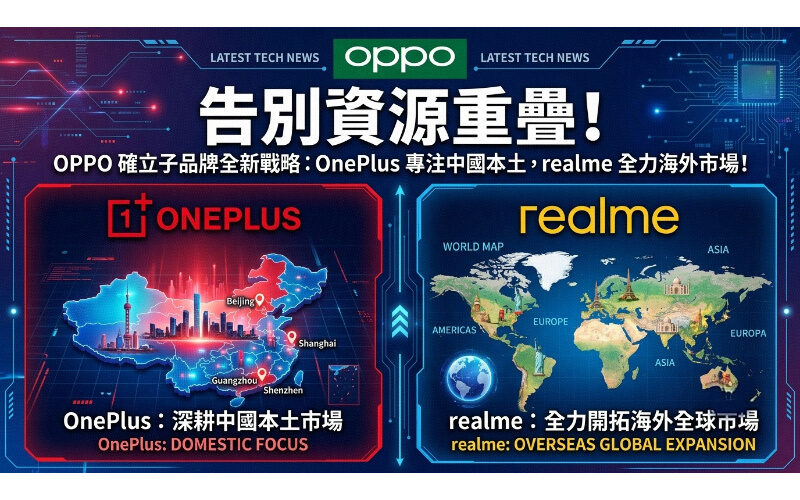
In order to further optimize resource allocation and enhance brand competitiveness, OPPO officially announced the new global strategic plan of its two major sub-brands OnePlus and realme. The core direction of this adjustment is very clear, which is to allow realme to fully focus on overseas markets, while OnePlus will invest its main resources in the Chinese local market.
Under the guidance of the new strategy, these two brands, which also focus on performance and gaming positioning, will usher in a complete division of battle lines. In the future, realme’s full range of new products will be completely focused on overseas market layout, which means that its subsequent new generation phones will no longer be available in online and offline channels in mainland China.
In contrast, OnePlus will narrow its overseas front, simultaneously suspend the pace of new product releases in Europe and North America, retain only regular product updates in the Indian market, and shift all core R&D and marketing resources to the Chinese local market.
In addition to adjustments to hardware and market positioning, this strategic collaboration also deeply covers the software system level. In the future, whether it is OnePlus or realme’s existing equipment, as long as it is on the official upgrade adaptation list, users around the world can freely choose to upgrade to the latest version of the ColorOS system, and there will no longer be a distinction between the underlying systems of different brands.
This change breaks the previous system barriers between brands, allowing the originally scattered R&D funds and technical talents to be highly concentrated on the core pivot of ColorOS. In this way, OPPO can not only avoid duplicating resources for the underlying development of multiple systems, but also help quickly build a unified global software ecosystem, thereby greatly improving the system update and iteration efficiency of the entire product line.
In the past period of time, OnePlus and Realme have had a lot of overlap in user groups and product pricing in the domestic consumer market. The competition between the two in the same price range has distracted the overall marketing and R&D effects to a certain extent. OPPO’s strategic adjustment this time is based on realme’s global brand recognition and mature distribution network accumulated over the years overseas. At the same time, OnePlus can concentrate all resources to accurately meet the needs of the mainland’s huge mobile gaming and high-performance players.
According to public data in 2026, OPPO’s share of the global smartphone market has ranked among the top three in the industry for two consecutive quarters. Among them, OnePlus’s domestic sales have also continued to maintain high double-digit year-on-year growth. After the two major sub-brands perform their respective duties and clarify the global product boundaries, and cooperate with OPPO’s comprehensive after-sales service system all over the world, it is expected that the overall market combat capability and brand comprehensive competitiveness will usher in a significant improvement.