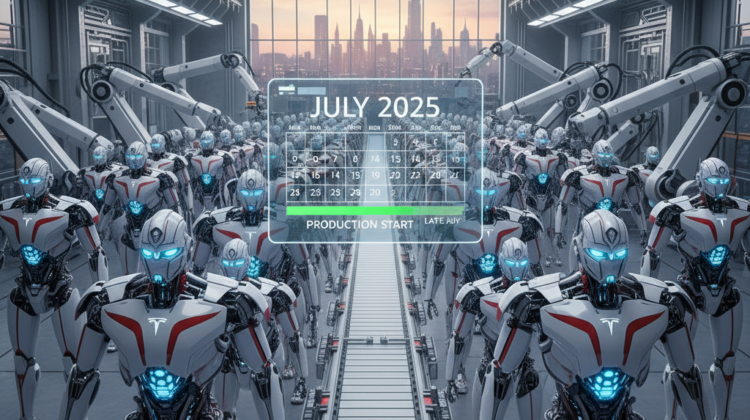
In late July—or possibly August—Tesla’s Optimus robot is set to enter production at the Fremont factory, but Elon Musk’s warning is the headline: early output will be “very slow,” and the ramp will be hard to predict. That combination—an actual production start date paired with aggressive humility about scale—signals a shift from optics to engineering constraints.
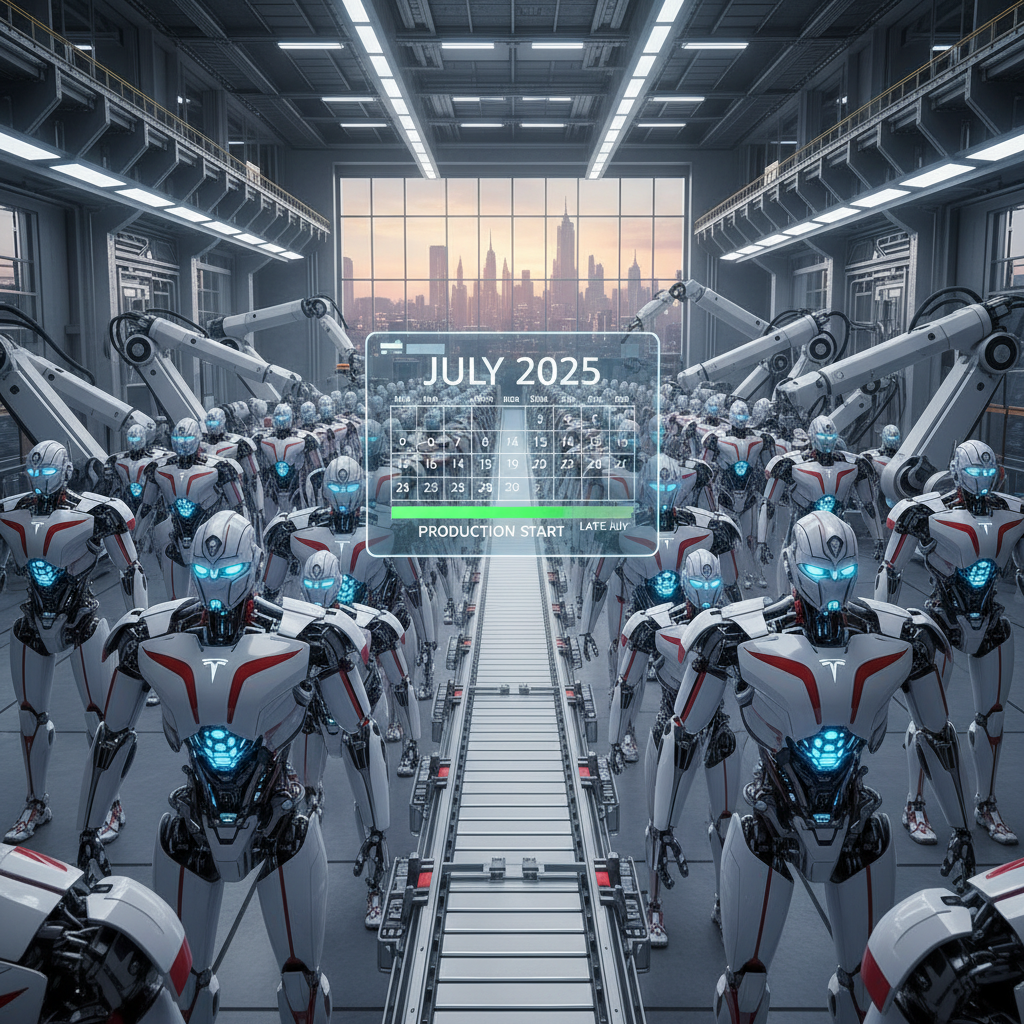
Fremont is the bet: production begins on a former auto footprint
Tesla’s plan places Optimus production at the Fremont site, starting on the former Model S/X production line. Using an existing industrial footprint matters more than it sounds: it shortens the time between “we can build it” and “we can build it repeatedly,” because the logistics of materials flow, staffing, tool deployment, and factory throughput are already worked out. The choice of Fremont also hints at how Tesla views Optimus—not as a lab experiment, but as a manufacturing program that must survive the brutal arithmetic of cycle time, yield, and maintenance downtime.
Musk’s comments frame the early phase as an engineering transition rather than a commercial launch. “Very slow” first outputs usually mean one or more of the following are limiting: specialized subassemblies (actuators, motors, precision gear components), test and calibration cycles, or integration steps that are still being tightened for repeatability. Even when a robot is “production-ready” in the technical sense, manufacturing readiness often lags behind robot readiness.
Q1 2026 “unveiling” and the rhythm of iterative manufacturing
Before the Fremont ramp, Tesla has already tied Optimus progress to a concrete milestone: the company says its third-generation Optimus—positioned for mass production—will be unveiled in Q1 2026. That’s an important sequencing choice: Tesla is effectively treating “show + refine” as a parallel track to “build + learn,” with design and manufacturing feedback feeding each other.
The Verge reporting also indicates Tesla is preparing a first production line that should commence before the end of 2026, with major upgrades in the pipeline. This suggests a two-stage reality. The late-July/august Fremont period is likely an early production pilot—more about learning manufacturing behavior than achieving high unit volumes—while the later 2026 timeline corresponds to a more stable, upgraded line designed to reduce rework and increase throughput.
In practical terms, that means Tesla may be aligning Optimus development with the kind of iteration cycle the company is known for in automotive: hardware evolves while production systems evolve too. The “third-generation” label matters because it implies Tesla has already confronted at least one major cycle of performance tradeoffs—whether that’s power efficiency, reliability, sensory robustness, or the ability to be assembled and serviced at scale.
Low-volume summer and an S-curve ramp: why the sequence matters
Teslarati’s update adds another piece of the puzzle: Musk suggests Optimus 3 production could start “this summer,” but at very low volumes initially, with a ramp to higher-volume output by summer next year. The language of an S-curve manufacturing ramp is telling. S-curves rarely describe marketing launches; they describe processes that start with instability—then gradually improve as yield rises, bottlenecks are removed, and operator familiarity grows.
This is where Musk’s caution becomes less of a warning and more of a roadmap. Early production at low volume is the statistical laboratory of manufacturing: it exposes defect modes, clarifies what “good enough” means for each subsystem, and forces the factory to prove it can deliver consistent units rather than occasional successes. As volume climbs, the improvements compound—automation and fixture use become more efficient, quality gates become sharper, and testing can become more targeted.
The key implication is that Optimus shouldn’t be judged only by “when it starts” but by how quickly Tesla converts early production into repeatable output. If the ramp truly resembles an S-curve, then the most meaningful milestone is not the first units off a line; it’s the point where scaling stops being a struggle and becomes a routine.
What Fremont production timing reveals about Tesla’s manufacturing strategy
Putting Optimus on a high-visibility manufacturing stage—Fremont, with an existing production line—signals that Tesla is treating robotics like a factory problem, not just a robotics problem. Automotive manufacturing experience matters here because robotics at scale is dominated by integration: component sourcing, assembly tolerances, safety testing, software calibration, and the ability to service and iterate without redesigning the entire system.
It also suggests Tesla understands that “robot readiness” and “factory readiness” are different clocks. An unveiling in Q1 2026 is a design-and-communication moment; a first production line before the end of 2026 is a systems moment; and late-July/august starting in Fremont is a learning moment. The dates aren’t just milestones—they’re a deliberate structure for how Tesla will reduce uncertainty.
For investors, engineers, and potential customers watching from the sidelines, the actionable insight is clear: the early period should be interpreted as calibration and yield-building. The real question to track over the next 12–18 months is whether Tesla transitions from “very low volumes” to a visibly faster throughput without sacrificing reliability—because that’s when robotics stops being a demonstration and becomes a product line.
Bottom line: track the ramp, not the announcement
Tesla’s Optimus timeline now has a rare combination of specificity and restraint: late-July/august production in Fremont, an Optimus 3 unveiling in Q1 2026, and a broader production-line push before the end of 2026, with an S-curve ramp toward higher volumes by summer next year. That pattern strongly suggests the company is engineering its way through manufacturing reality rather than relying on a single breakthrough.
If Tesla executes, the next “tell” won’t just be dates—it will be the speed at which output increases and how reliably each incremental improvement lands on the production floor. The smartest next step is to monitor whether the factory learns quickly enough to turn a slow start into a compounding ramp.