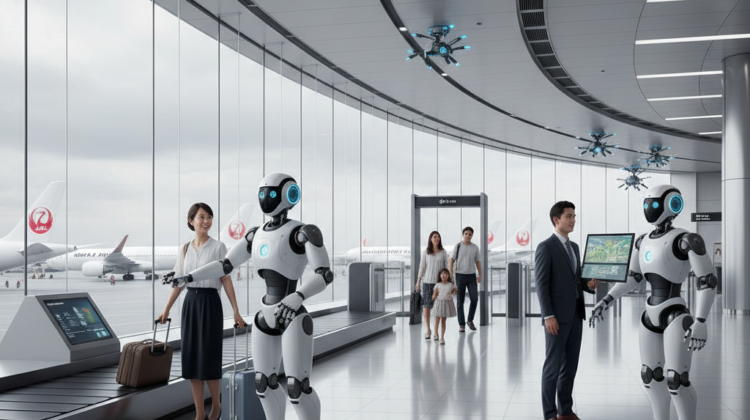
In just a few days—starting May 1 and moving through May 7—humanoid robots jumped from showpieces to scheduled work: baggage loading at Haneda, full-scale production in California, and a manipulation model upgrade that targets humanlike dexterity. That timeline matters because it signals a shift from “can it move?” to “can it operate reliably in messy, real-world workflows?”
From demos to duty cycles: why airports and warehouses are the first proving grounds
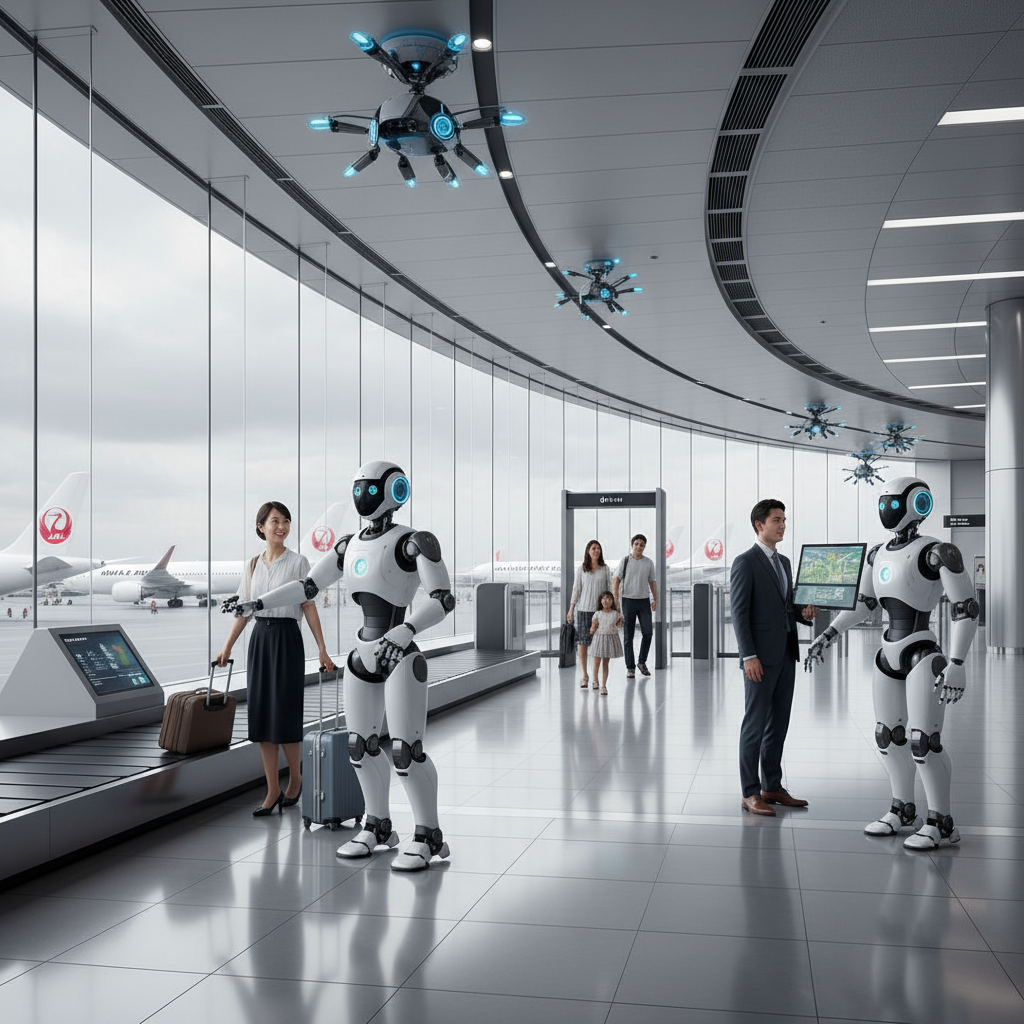
Japan Airlines’ May 2026 trial at Tokyo Haneda is one of the clearest signals that airports are becoming the new humanoid proving ground. The two-year pilot, starting in May with GMO AI & Robotics, is explicitly framed around ground-service tasks—baggage loading and cabin cleaning—areas where human workers already run repeatable sequences under tight time pressure. In practice, that means robots must handle variability: different bag sizes, uneven handling surfaces, and the operational reality of aircraft turnarounds that compress decision-making into minutes.
The strategic logic is straightforward. Airports are both predictable and chaotic: predictable in their recurring processes, chaotic in their constant mix of luggage types, passenger behaviors, and schedule-driven constraints. Humanoids are often marketed for “general purpose” movement, but the first industrial metric is usually narrower: time-to-complete a task, error rate per shift, and recovery performance when something goes wrong—like an unexpected obstruction or a bag that doesn’t match the robot’s prior assumptions.
That’s why pilots like this tend to focus on bounded work—loading and cleaning rather than full passenger interaction. If a humanoid can consistently execute a small set of high-throughput tasks in a controlled operations environment, it becomes easier to scale the same hardware and software stack across more gates, more shifts, and eventually more airports.
The manufacturing thesis: scaling “person-shaped” hardware means solving production, not just perception
Production is now part of the story, not an afterthought. On May 7, 1X Technologies said it began full-scale production of its NEO humanoids at a new 58,000-square-foot facility in Hayward, California. The company’s “vertically integrated” framing—via a factory OS—signals that the competitive edge is shifting toward repeatable manufacturing and deployment logistics, not only the robot’s controller or its sensors.
Humanoids have an inherent engineering tax: more joints, more actuators, more mechanical tolerances, and more failure modes than simpler industrial arms. Scaling hardware therefore requires a production strategy that makes quality consistent across units. A 58,000-square-foot facility is not just a headline—it implies capacity planning and workflow design for assembling complex articulated systems at a throughput pace aligned with customer trials and industrial pilots.
The key question for buyers is whether the company can maintain reliability as production volume rises. Early humanoid deployments will be judged less on cinematic motion and more on mean time between failures, serviceability, and how quickly a maintenance team can swap worn components. The “factory OS” language suggests the product lifecycle—calibration, QA testing, and field diagnostics—is being treated as a first-class system.
Dexterity and control: a humanoid’s real breakthrough is manipulation that matches human intent
Hardware alone doesn’t close the gap. The May 6 TechCrunch report on Genesis AI underscores that the race is also about models that can translate humanlike goals into accurate, contact-rich actions. Genesis AI, backed by Khosla Ventures, demonstrated a robotics model dubbed GENE-26.5 alongside manipulation using a robotic hand designed to match human hand form factors closely.
In humanoids, “form factors” are not a cosmetic detail—they directly affect grasping strategies. A human-shaped hand supports familiar grasp primitives (pinch, wrap, hold) and can adapt to partial occlusion and irregular objects. For airport tasks, the analog is immediate: luggage isn’t a standardized cylinder. It’s a bag with handles, straps, corners, and varying stiffness, and successful loading depends on stable contact, correct force application, and recovery when the bag slips or rotates unexpectedly.
The implication is that next-generation humanoids will increasingly depend on generalizable manipulation models rather than narrowly tuned behaviors. If GENE-26.5 improves how a robot plans and executes dexterous actions—especially under imperfect sensing—it makes the step from “robot arms that can reach” to “humanoids that can handle” much more believable for industrial operators.
What these developments collectively mean for the next 12–24 months
Put these three threads together—JAL’s May 2026 airport pilot, 1X’s May 7 production start in a 58,000-square-foot California facility, and Genesis AI’s GENE-26.5 dexterity demo. The industry is converging on the same bottleneck: making humanoids dependable enough to run on a schedule, while improving manipulation capability so tasks don’t require constant supervision.
For operators considering humanoids, the actionable starting point is not “how humanlike does it look?” but “what is the fault model?” Ask the vendor what happens when the robot mis-grips: does it retry autonomously, does it fall back to a simplified mode, or does it require a human intervention loop. In ground-service environments like Haneda, those recovery behaviors can determine whether robots reduce labor friction or simply shift the burden to staff.
For manufacturers, the lesson from 1X’s factory bet is that scale requires system-level discipline. Customers will push for transparency on calibration drift, component wear, and service time. If factory OS capabilities translate into tighter QA and faster diagnostics, humanoids can move from “pilot prototypes” to “repeatable capital equipment.”
For robotics developers, Genesis’s push toward human-form dexterous hands and improved manipulation models points toward a practical research direction: prioritize skills that translate across object categories and unpredictable contact. If manipulation generalization improves, robots become more useful across changing luggage mixes, toolkits, cleaning supplies, and other day-to-day variations that make industrial work harder than static benchmarks.
Bottom line: the humanoid era begins with reliability, then breadth
These dates—May 1 for the Haneda trial launch, May 6 for the manipulation-model leap, May 7 for the production scale-up—show humanoids entering a new phase. The next wave of progress will be measured by operational uptime, maintenance turnaround, and how well dexterity models handle messy real objects—not just by how convincingly a robot can mimic movement.
If you’re evaluating humanoids now, focus on three questions: (1) which specific workflows are being automated first and how constrained they are, (2) whether the robot can recover from contact errors without slowing the entire operation, and (3) whether the supplier has a credible path from pilot-scale prototypes to reliable, serviceable units. In the humanoid market, those answers will decide whether robots become a novelty—or a new category of industrial labor.