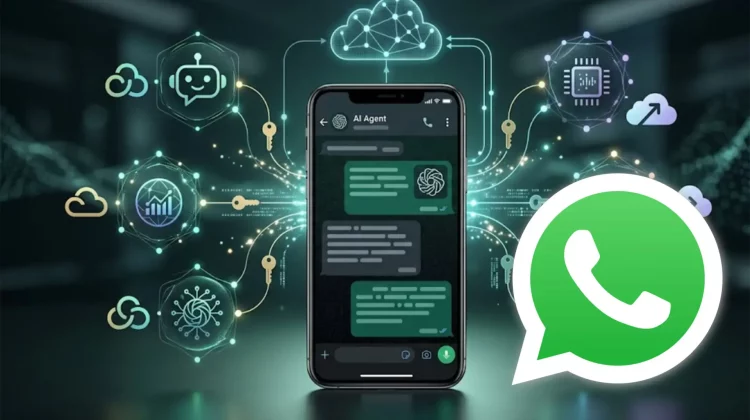
The world’s most widely used messaging service is taking solid steps toward a transformation that could redefine its purpose. WhatsApp has started testing the integration of artificial intelligence agents developed by third parties. The new feature will allow users to have conversations with external assistants without leaving the app. The feature was discovered in the Android version 2.26.35.3 beta and is currently only available to a small group of testers in select countries, but it aims to become a core feature of the platform.
This concept is not new in the digital ecosystem, but applying it to an application with more than 350 million users is unprecedented. Users can interact with these agents just like regular contacts without opening a website, installing an extension, or using a separate app. Each contact will have their name, avatar, and a separate conversation in the chat list. The feature, spotted by WABetaInfo, adds a dedicated section in WhatsApp settings to manage these contacts.
What is an agent? How to configure proxy?
To clarify, not all agents are based on generative AI. The platform supports both assistants developed using OpenAI, Google or Anthropic APIs, as well as simpler bots. They respond to preset commands, similar to those already available on Telegram. The key difference is the degree of autonomy: agents can understand natural language instructions and perform complex tasks, whereas traditional chatbots are limited to pre-programmed responses.
The installation process is simple but requires certain technical steps. Users can create agents in WhatsApp settings and assign them a name and avatar. The application will then automatically generate an API key. You must copy this key and enter it into the external service hosting the proxy to establish the connection. Each account can be associated with up to five different agents, so you can use specialized tools for different tasks without confusing them.
Once registration is complete, the agent will appear as a separate conversation. Users can send messages and receive replies just like in other chat software. The advantage of this is that there is no need to switch applications. Additionally, post-deletion management functionality is included: you can modify an agent’s name or photo, temporarily disconnect them, or delete them completely. If deleted, the connection will be disconnected immediately, but the conversation history will still be visible.
Restrictions and privacy: What you need to know
Integration is not without important nuances when it comes to security. Chats with third-party agents are not protected by end-to-end encryption. Unlike a typical conversation between people, this is due to operational reasons: the message must be transmitted to the proxy provider’s servers to be processed and a response generated, which breaks the end-to-end (E2EE) model based on the Signal protocol used by WhatsApp.
Another related limitation is the isolation of agents. The tool can only access messages shared by users in specific conversations. Can’t view other chats, contacts, or multimedia files on the account. These agents are also not currently allowed to be added to groups or communities, so all interactions remain one-on-one.
WhatsApp also warns that responses from AI-based agents may contain errors, so it is recommended to verify important information before taking action. This warning is especially important for people who plan to use these assistants in a professional setting. Or for managing sensitive data where exposure to external providers is a consideration.
Meta’s strategy: Beyond third-party proxies
This beta does not occur in isolation, but is part of Meta’s broader development roadmap. The company has been working for nearly two years to build WhatsApp into a conversational software platform for businesses and consumers. According to TechCrunch, in June 2026, Meta launched Meta Business Agent globally, a customer support assistant integrated into WhatsApp Business and Instagram direct messages.
The bot is already capable of answering frequently asked questions, recommending products, scheduling appointments, screening potential customers, and routing conversations to human agents when necessary. Starting August 1, 2026, Meta Business Agent will charge businesses $2 per million tokens. According to Yahoo Finance, this equates to about 4 to 5 cents per transaction. Currently, the commercialization process has begun and points to a business model based on artificial intelligence consumption.

The next step will be “Project Hatch,” according to internal documents cited by The Information and reported by Forcaster News and American Market. This consumer agent platform will allow users to delegate complex tasks such as: Shop with WhatsApp and AI Search for products on Etsy or manage your Outlook calendar This feature will be available directly within the messaging interface. A release is expected in the coming weeks, but Meta officials have yet to officially confirm those plans.
The model used by Hatch, known internally as Watermelon, achieved performance comparable to GPT-5.5 in Meta’s internal tests, while delivering roughly ten times the computing power of its predecessor. The company is reportedly considering launching a premium subscription service for up to $199,99 per month for heavy users. This number is much higher than the Meta One Plus and Premium tiers that have been tested in markets such as Singapore and Guatemala.
European context and adoption in Spain
In Europe, these features emerge within a complex regulatory framework. EU authorities have put pressure on Meta to allow third-party AI assistants to enter the market. To promote competition in a growing market, this means that in the future users will be able to choose between different AI providers within the same application.
In Spain, WhatsApp’s penetration rate exceeds 95% in the southern region, and users spend an average of more than 84% of their screen time on this type of instant messaging interface. Although concerns over data privacy remain, the use of conversational agents in Spanish business is growing. Especially when discussing the Meta ecosystem. Companies like Blip, present in Spain since the acquisition of GUS in 2023, are working to integrate these solutions and close the gap with regions such as Brazil or India.
Finally, it’s worth noting that the third-party proxy feature in WhatsApp is still in a very early testing phase. Meta has not yet confirmed when the feature will be available to all users. It is unclear whether WhatsApp will be launched on the Android platform first or on the iOS platform as well. But what is certain is that instant messaging is evolving towards a platform model, in which conversational artificial intelligence will play a central role, and WhatsApp hopes to lead this change.