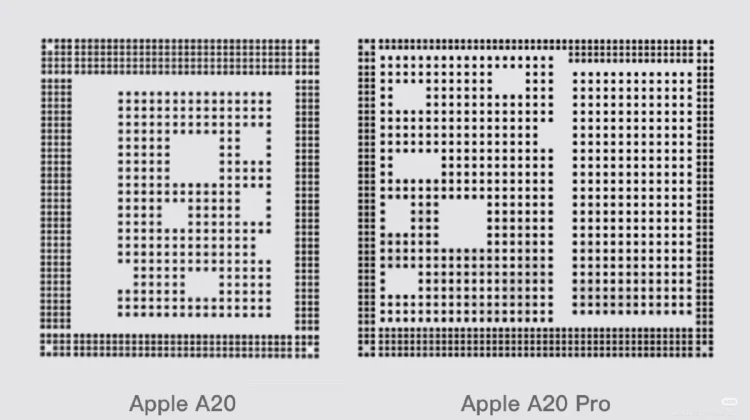
An image that appears to be a board design drawing was posted on X (formerly Twitter) for the A20 Pro, which is expected to be installed in the iPhone 18 Pro series and foldable iPhone, and the A20, which is rumored to be installed in the iPhone 18 and iPhone 18e.
If the posted image is correct, the A20 Pro and A20 may use different packaging technology.
A20 Pro may be WMCM and A20 may be PoP
The right side of the posted image is said to be of the A20 Pro, and like the previously leaked images of the logic board equipped with the A20 Pro, it appears to use WMCM (Wafer-level Multi-Chip Module).
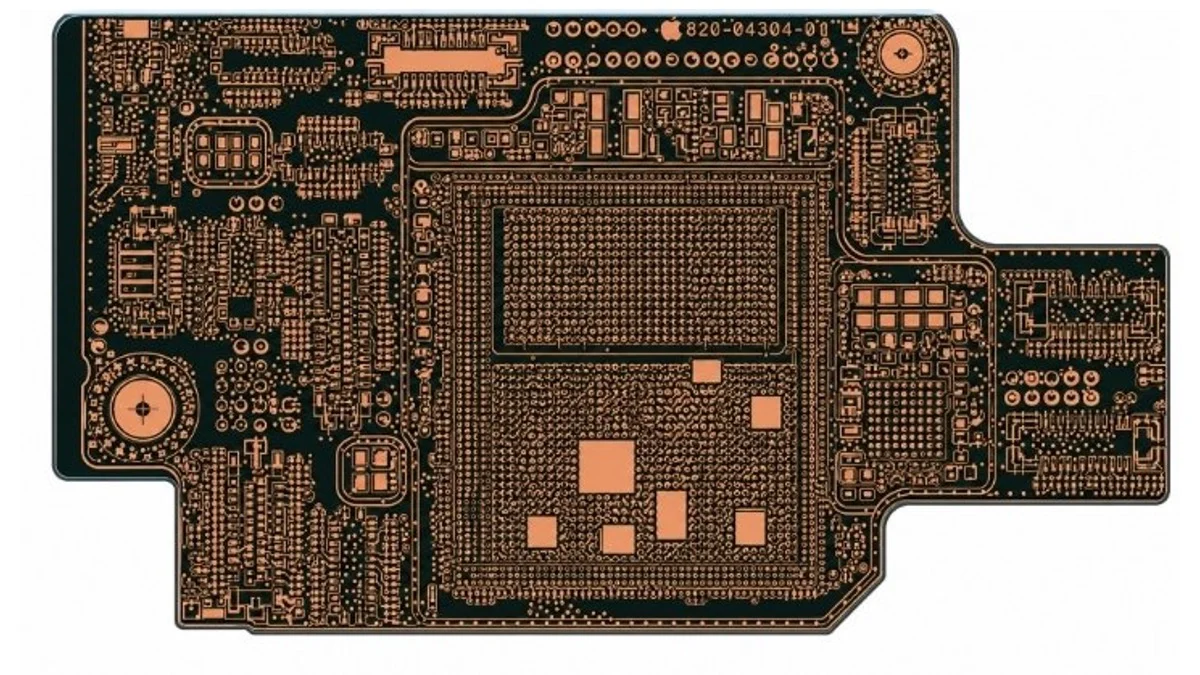
In WMCM, DRAM is not stacked on top of the application processor as in traditional PoP (Package-on-Package), but placed horizontally within the same package. Regarding the A20 Pro, the adoption of WMCM was also suggested from the logic board image that is said to be for the iPhone 18 Pro.
On the other hand, the A20 drawing on the left side of the image appears to use a conventional PoP that stacks DRAM on top of the processor.
If this image shows the actual design, Apple will use different packaging technologies for the Pro and standard models even in the same A20 generation.
What are the benefits of WMCM?
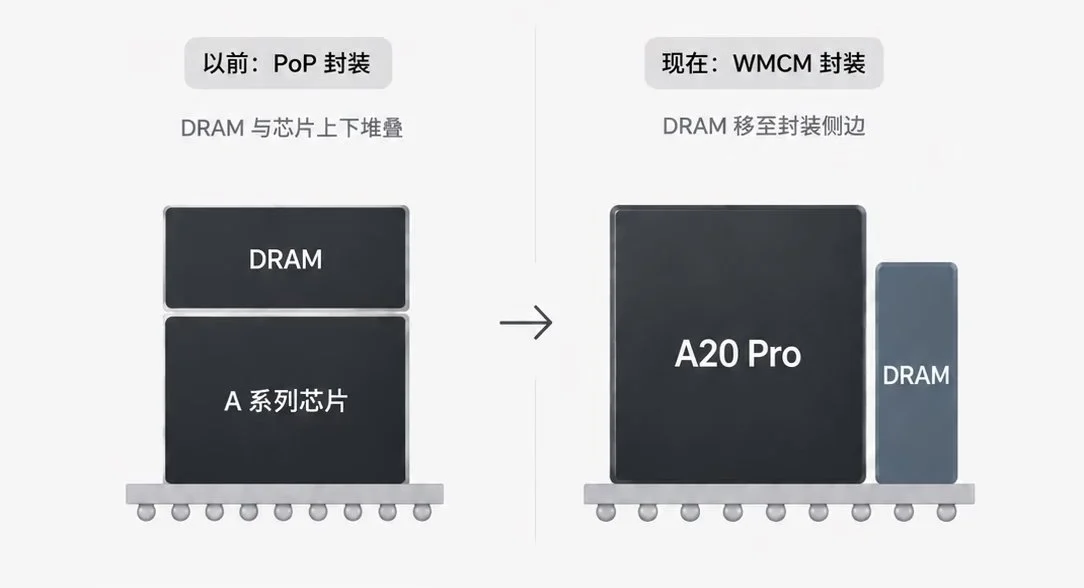
A major feature of WMCM is that processors and DRAM can be arranged horizontally. In conventional PoPs, DRAM is stacked on top of the processor, so heat tends to concentrate in the package.
By moving DRAM laterally in WMCM, thermal interference between the processor and memory can be suppressed, and heat dissipation performance can be expected to improve during sustained high loads.
Does it reflect the actual size ratio of A20 Pro and A20?
Although the poster did not mention it, the part that is said to be the A20 Pro in the image is drawn larger than the A20. However, it is unclear whether this blueprint represents the actual die area in accurate proportions.
If the actual size ratio is reflected, the A20 Pro has a larger CPU, GPU, Neural Engine, etc. than the A20, and there may be a difference in the number of transistors installed.
The poster did not mention them, so at this point it is difficult to judge the actual die area and number of transistors just from the size on the image.
Is there a difference in DRAM capacity?
The iPhone 18 Pro, iPhone 18 Pro Max, and foldable iPhone equipped with the A20 Pro are expected to be equipped with 12GB of DRAM. On the other hand, analyst Ming-Chi Kuo predicts that the iPhone 18 and iPhone 18e equipped with A20 will be equipped with 9GB of DRAM.
In that case, there will be a clear difference between the A20 Pro and A20 not only in packaging technology but also in the DRAM capacity that can be combined. However, there are other predictions that the iPhone 18 will be 12GB and only the iPhone 18e will be 9GB, so information is divided about the memory capacity of the standard model.
Expected products installed in A20 Pro and A20
A20 Pro and A20 may be included in the following products in the future:
| Apple silicon | Installed products |
| A20 Pro | iPhone18 Pro iPhone18 Pro Max folding iphone iPhone Air 2 New iPad mini (equipped with organic EL) MacBook Neo 2 |
| A20 | iPhone18 iPhone18e iPad |
Regarding the A20 Pro, it is also suggested that it will be installed in the logic board image that is said to be for the next iPad mini.
iPhone 18 series CPU A20 vs A20pro CPU pic.twitter.com/pfPNSKZYJm
— Lusi Roy (@LusiRoy7) September 2, 2026
Photo: Lusi Roy (@LusiRoy7)/X
Source: iPhone Mania