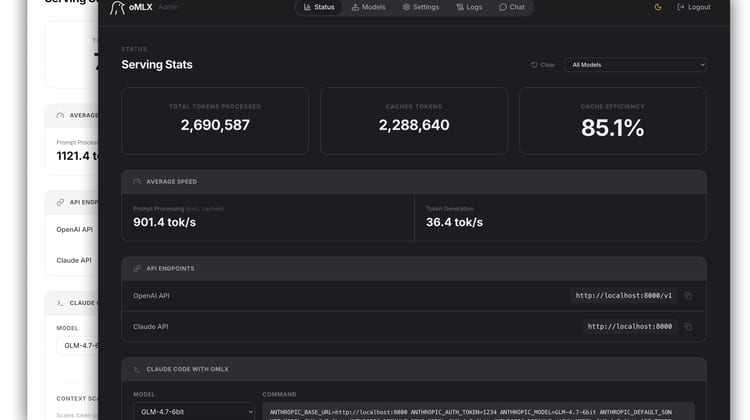
oMLX puts a full LLM server in the Mac menu bar. The free Apache-2.0 tool from developer Jun Kim runs MLX models with continuous batching, keeps past context cached between requests, and answers both OpenAI-style and Anthropic-style API calls. Version 0.7.3, published Oct 31, 2026, is the build to install today.
What oMLX serves on localhost:8000
Any OpenAI-compatible client can connect to http://localhost:8000/v1. The same server also answers Anthropic Messages calls on /v1/messages, so coding tools that expect either API format work without a proxy. This is a step up from the bare mlx_lm.server OpenAI-compatible setup we covered before, which speaks one dialect and has no dashboard.
Two web pages are built in. /admin is the dashboard for model management, Hugging Face downloads, benchmarks and per-model settings. /admin/chat is a plain chat page over whatever is loaded. Models are found in subfolders of the model directory, default ~/.omlx/models. Text models, vision models, embedding models and rerankers are all picked up automatically.
Install 0.7.3 from the DMG or Homebrew
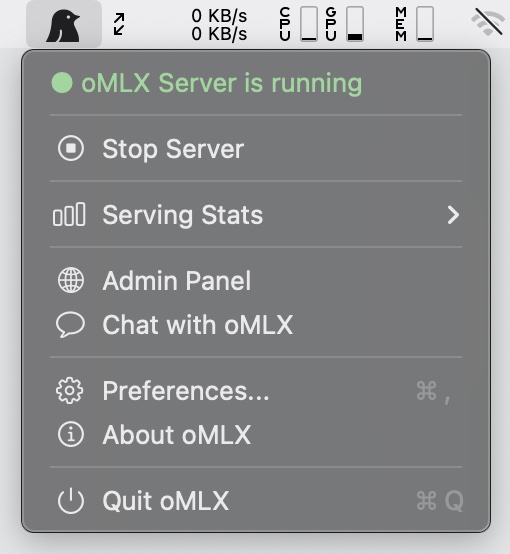
Two install paths. Grab oMLX-0.7.3-macos26-27.dmg or oMLX-0.7.3-macos15-sequoia.dmg from the oMLX GitHub Releases page and drag the app into Applications. This path needs no Xcode. Homebrew users run brew tap jundot/omlx https://github.com/jundot/omlx, then brew install jundot/omlx/omlx. Add the --with-custom-kernel flag only if full Xcode and the Metal toolchain are installed, because that build compiles native kernels. The plain install skips them and still works.
Both paths require macOS 15.0 (Sequoia) or later and Apple silicon, listed as M1 through M5. Homebrew and source installs need Python 3.11 to 3.13. Upgrade later with brew update && brew upgrade omlx. The oMLX README lists every requirement and flag.
The KV cache keeps long contexts on the SSD
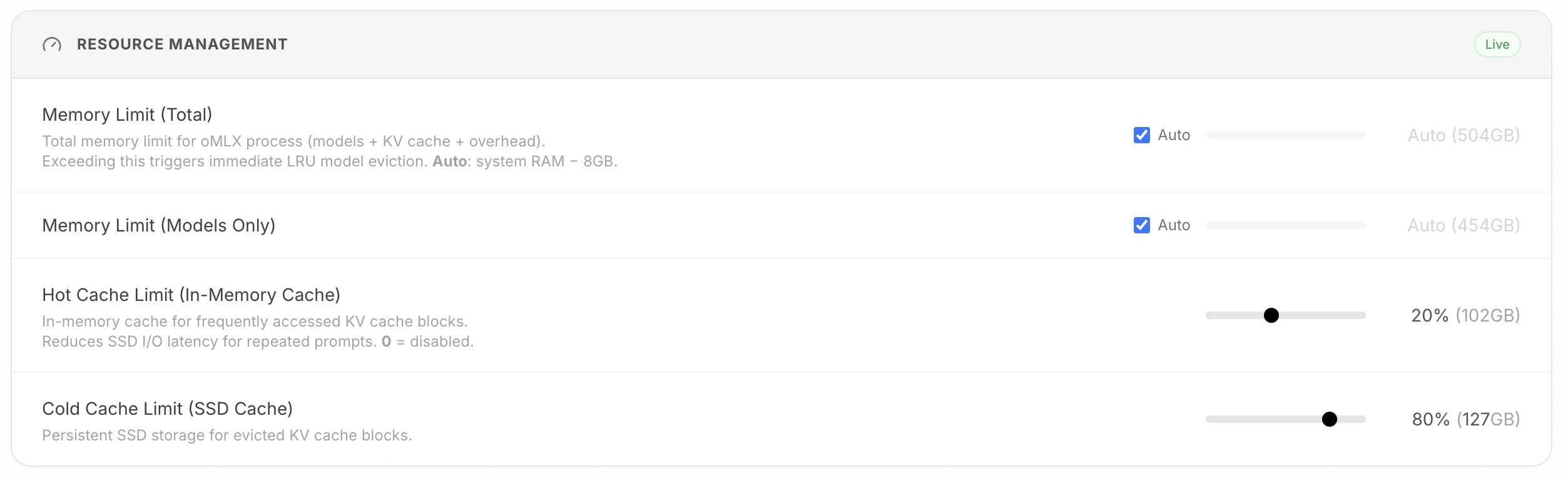
The cache is block-based, with prefix sharing and copy-on-write, in two tiers. The hot tier is RAM. When it fills, blocks move to the SSD in safetensors format. The next request with a matching prefix restores them from disk instead of recomputing, and that works even after a server restart. For long coding sessions where an agent resends history every turn, this is the part that saves the time. Kim writes that he built oMLX to keep context cached while working with tools like Claude Code. If you instead push Ollama to hold more in memory, see our Ollama context length tip for long chats and coding tools.
Enable the SSD tier with omlx serve --model-dir ~/models --paged-ssd-cache-dir ~/.omlx/cache. The default cache budget is "auto", about half of free disk space plus existing cache files. Use --paged-ssd-cache-max-size 20GB for a fixed cap. Affine4 and Affine8 KV compression sit under Model settings → Memory Saving → KV cache compression in the admin panel.
Start the server and point a client at it
Homebrew and app installs both get the lifecycle commands. omlx start runs the background service with zero-config defaults, ~/.omlx/models on port 8000. omlx stop and omlx restart round it out; brew services info omlx shows whether it is up. For a foreground run: omlx serve --model-dir ~/models. Check the endpoint with curl -s http://localhost:8000/v1/models.
Any MLX checkpoint dropped into the model folder works, like webAI's TwIL-8B model we ran earlier this week. The admin dashboard also wires up agents in one click. The README lists OpenClaw, OpenCode, Codex, Hermes Agent, Copilot, Pi, Mistral Vibe and DeepSeek Harness. Settings land in each tool's own config, no manual editing.
What 0.7.4.dev1 adds, and why to wait
Dev build 0.7.4.dev1 landed Nov 4, 2026 with the Prefill Accelerator. It splits prefill work across two Macs: layers of long prompts run on the second machine while the model and its cache stay on the main one. It ships in a dev tag and multi-Mac distribution is still experimental. For now install 0.7.3 and let brew upgrade omlx move you forward when these features land in a stable tag.
One more note on the project itself. Hugging Face announced on Sep 22, 2026 that Kim joined the company to support the MLX community while continuing to lead oMLX.
Photo: jundot/omlx on GitHub
Source: GitHub Releases, Hugging Face blog