India's 2026 festive season cut deep into smartphone sales. Counterpoint Research research analyst Shubham Singh said in a post-festive check dated November 19 that India festive smartphone sales fell an estimated 22% year-on-year from October 8 to November 10. Counterpoint had forecast a 12% decline before the season. Rising DRAM and NAND prices pushed device prices up, and many buyers stayed away.
Market value stayed broadly flat. A 22% volume decline leaves 0.78 of last year's units, and a 28% ASP gain multiplies that by 1.28. The result is close to 1.00, so higher prices almost exactly offset the missing units. Counterpoint marks the figures as preliminary estimates, subject to revision, and published no festive unit total.
India festive smartphone sales fell 22% as discounts narrowed to 10–25%
Festive discounts landed at 10–25%, down from 35–40% in 2025. Even discounted entry-level models were generally priced higher than a year ago, which put upgrades out of reach for many price-sensitive buyers. The Hindu carried the same check on November 20. Brands leaned on no-cost EMIs, bank offers and trade-ins instead, and finance drove 48% of smartphone sales. Earlier DRAM-driven price increases across Indian phone brands had already squeezed the same margins.
The first wave, October 8 to 18, fell 19% year-on-year. Online sales declined as higher consumer traffic failed to turn into conversions. Mainline retail started slow. Footfalls recovered during Navratri, but conversions stayed weak. Brands exposed to the sub-INR 20,000 segment were hit hardest and declined by close to 50%. Ai+ Smartphone was the fastest-growing brand and sold over 1 million units in the festive period. New entrants Mivi and Boltt did better than expected.
Apple iPhone festive sales fell by double digits while Samsung kept 21% share
Samsung finished the season with a 21% share, overtaking vivo, as its own sales fell just 8% against a market decline of 22%. The Galaxy S25 Ultra and Galaxy S25 drew strong demand. Samsung delayed price hikes until after the sales and managed inventory better than rivals. vivo and OPPO declined 21% and 24%, holding up better in mainline retail through retailer incentives and bundled offers but weaker online. Xiaomi declined sharply, then picked up around Diwali on the Redmi Note 15 and Note 17 series. Google was the fastest-growing brand in the ultra-premium segment above INR 45,000 and sold its highest-ever number of Pixel devices during the season. No Pixel unit count is published.
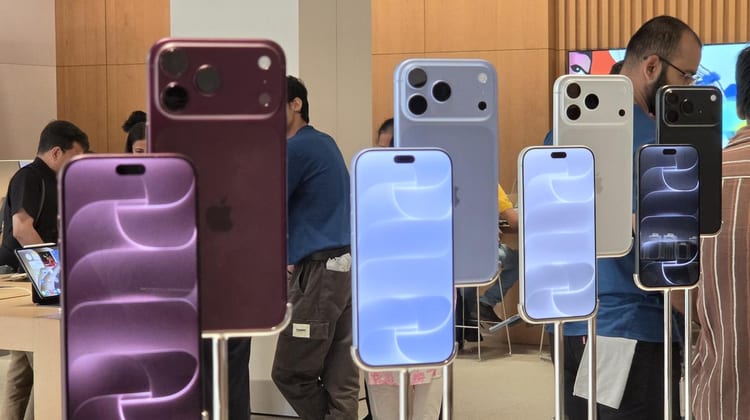
Apple's sales declined by double digits despite strong feedback for the new iPhone 18 Pro series and continued consumer interest in the iPhone 17. Counterpoint gives no precise Apple percentage. Refurbished iPhones saw strong demand as buyers looked for cheaper options, and that hurt new iPhone sales, especially the n-1 and n-2 series. Retailers did better where pre-price-hike inventory was still on hand. Counterpoint's earlier iPhone 18 Pro sales check and the jump in old iPhone prices in the Indian market both sit behind this mix.
 Photo: Apple
Q3 2026 shipment numbers cover a different window than the festive season
Some figures circulating next to this report come from a different quarter. Business Standard, updated November 20, rounded up Q3 CY2026, meaning July to September. IDC put shipments at 36.8 million units, down 23.3% year-on-year, and called it the weakest festive quarter in a decade. IDC also had Apple shipments down 25% for that quarter, while the iPhone 18 Pro and Pro Max made up more than 30% of Apple's Q3 shipments. Those are quarterly shipment figures. The festive-window Apple number stays "double digits" for sales, from Counterpoint. Counterpoint's earlier Q3 check on India smartphone shipments put the quarterly contraction at 20%. Moneycontrol, which followed the festive report on November 20, calls India the world's second-largest smartphone market. The two windows do not overlap: Q3 ends in September, the festive season starts on October 8.
Counterpoint published no festive unit total and marks the data preliminary
The festive write-up carries two charts, one on sales in million units and one on brand share, but the text publishes no absolute festive unit total. Any specific millions-of-units figure for October 8 to November 10 is not from this report. The same goes for a precise Apple percentage for the festive window. Counterpoint marks the whole post-festive check as preliminary, and revisions are possible as more data lands.
Photo: Haider Ali Khan / The Hindu (featured), Apple (inline)
Source: Counterpoint Research, The Hindu, Moneycontrol, Business Standard