Although Google’s Nano Banana AI image generation function is practical, the watermark visible in the lower right corner that was forced to be added in the past often affected the look and feel of the picture. In order to cater to user needs and catch up with the watermark-free experience of ChatGPT, Google has finally opened the function of removing visible watermarks from AI-generated media on the Gemini and Flow platforms. This update also covers Gemini Omni video and Lyria music generation, allowing creators to enjoy greater freedom while retaining the underlying invisible watermark for content traceability.
Google’s Nano Banana image generator is very practical, but the images it generated in the past had a visible watermark in the lower right corner. Compared with ChatGPT, the latest model can directly generate watermark-free images. This mandatory mark makes many users who pay attention to image layout inconvenient. In order to improve the user experience, Google has finally relaxed the restrictions and allows users to choose to remove this watermark.
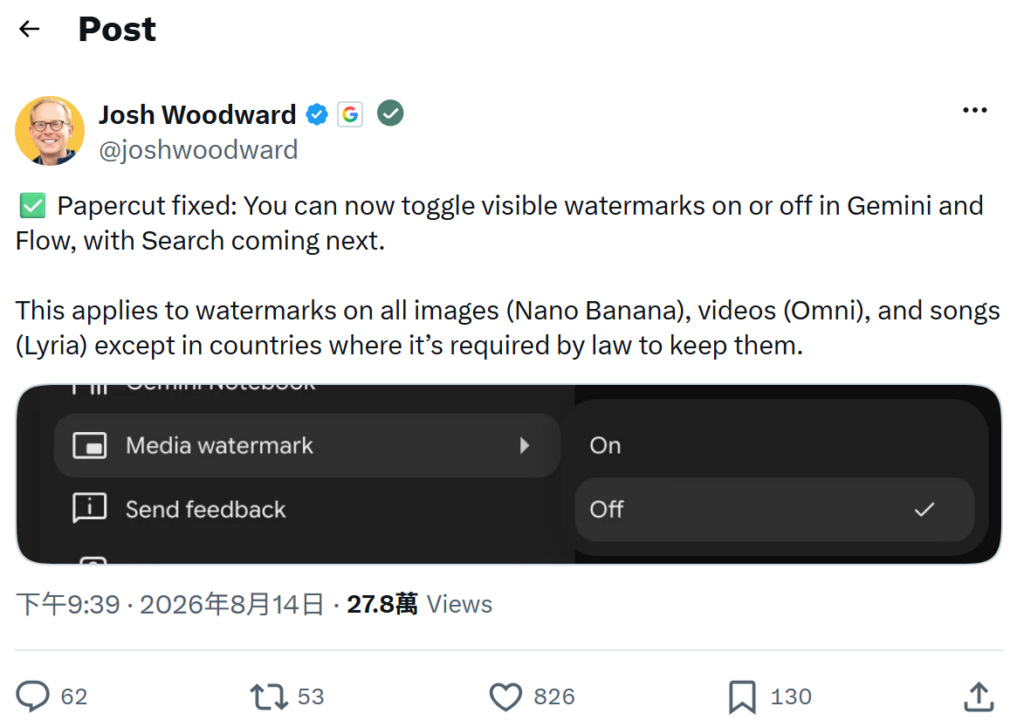
Relevant new settings will be provided first in the Gemini and Flow interfaces, and the AI mode of Google search will also add this support later. The coverage of this update is quite comprehensive. In addition to Nano Banana images, videos generated by Gemini Omni and music composed by Lyria will be able to apply the watermark removal setting in the future. The only exception is when the laws of some countries or regions explicitly require that the AI mark must be retained, and users in that region will not be able to apply this hidden feature.
Although watermarks visible to the naked eye can be removed, this does not mean that AI works will completely lose their way of identification. Google will still retain the SynthID invisible watermark and C2PA relay data hidden in the file. Therefore, if you query Gemini about the source of a certain image, the system will still be able to read the underlying data and truthfully indicate that the image was generated by AI. This move not only gives creators greater freedom, but also takes into account the security of content traceability.