One of the fastest-growing beauty claims right now—“exosome serum”—is being sold with the same urgency as a limited-time discount, even as the category still lacks the kind of standardized, ingredient-level proof consumers usually expect from skincare. NBC Select’s May 9, 2026 deal story for Medicube’s “Zero Exosome Shot” frames exosomes as smoothing agents that can “minimize the appearance of pores,” while a separate industry trend piece dated December 19, 2025 links exosome serums to the broader “injectable skincare” movement that pairs them with hyaluronic acid (HA). That combination—aggressive retail claims plus an emerging protocol mindset—explains why consumer interest is surging faster than the evidence framework.

What “exosome serum” is trying to do—beyond the buzzword
Exosomes are tiny extracellular vesicles that, in research contexts, are discussed as delivery vehicles for cellular signaling components. In skincare, they’re typically positioned as something more “active” than standard moisturizers, with marketing language emphasizing renewal, calming, and texture improvement. The key practical translation for consumers is this: exosome serums are being sold as a way to influence how skin behaves—especially in the areas people notice daily, like roughness, pores, and dehydration—rather than simply coating the skin.
NBC Select’s coverage illustrates how the category is being packaged: Medicube’s exosome serum is promoted around visible outcomes like smoother-looking skin and a reduced look of pores. That’s significant because “pore appearance” is not a single measurable target; pores look larger when pores are stretched by oil, thickened skin surface buildup, or when dehydration makes skin texture appear uneven. So when exosome serums make pore-minimization claims, the likely mechanism must be more complex than “one ingredient shrinks pores.”
The 2026 “injectable skincare” angle: why HA is showing up with exosomes
The December 19, 2025 trend discussion makes the category’s strategic direction clear: exosome serums are increasingly being treated as part of an injectable-adjacent routine. Rather than relying solely on topical hydration, these protocols often pair exosome claims with HA (hyaluronic acid), which is a proven humectant that improves short-term hydration and can temporarily make texture look smoother. In other words, even if exosomes contribute a subtler effect, HA can deliver immediate “skin feel” and “skin look” improvements—creating a faster feedback loop for consumers.
This matters because skincare effect sizes often depend on how quickly products show results. HA can improve hydration within hours, while longer-term texture changes depend on barrier health, turnover, and consistent use. Pairing HA with an “evidence-adjacent” story like exosomes can make the whole routine feel more “treatment-like,” even when the topical delivery is fundamentally cosmetic.
BioInformant’s January 1, 2026 industry overview further reinforces the clinic-to-retail blending: exosome-based approaches are described as being used commercially and in professional treatments, and the narrative suggests that exosomes have moved from experimental science toward practical—if still fast-evolving—application. For consumers, the risk is confusing “used in clinics” with “the same dosing, formulation, and endpoints are validated for at-home serums.” Different delivery systems (injectable vs. topical) can produce different outcomes and different safety profiles, even if the name sounds identical.
Marketing pressure vs. scientific standards: what to watch for
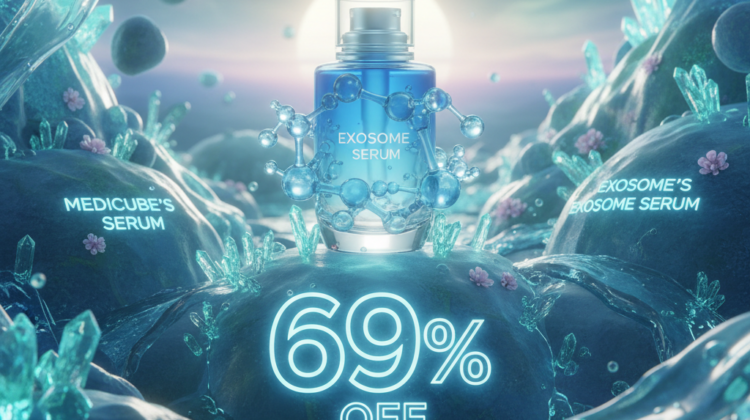
The May 9, 2026 NBC Select deal highlights a $ savings framing (“Save 69%”) for Medicube’s exosome serum, which signals something bigger than consumer savings: it’s a product category competing for mindshare in real time. Deal-driven coverage can be effective, but it also encourages a “try it now” mindset—before buyers have the information needed to evaluate whether exosome serums are likely to outperform familiar texture and hydration staples.
So how do you assess an exosome serum like a clinician-minded buyer? Start with the ingredient reality check. If the label leans heavily on the word “exosome” but provides little clarity on the source, manufacturing process, or how exosome activity is preserved (especially through formulation and shelf life), treat claims as more speculative. Then look at what else is doing the heavy lifting: HA for hydration, barrier-support ingredients (like glycerin or ceramides if present), and texture agents (such as exfoliating acids or retinoid-like compounds if included). If a product’s visible promise can be explained by conventional ingredients, exosomes may be a branding layer rather than the primary functional driver.
Finally, be wary of outcome language that’s too broad to measure. “Smoother skin” and “minimize the appearance of pores” are plausibly influenced by hydration, reduced inflammation, and surface smoothing—but these are not the same as validated pore-size reduction. Consumers often interpret “pores look smaller” as structural change; in practice, many skincare products make pores look smaller by improving surface reflectivity and reducing how much oil and debris accumulate at the follicle opening.
Actionable buying and usage strategy for exosome serums
If you’re considering an exosome serum in 2026, you’ll get better results by treating it as a texture-and-hydration support step rather than expecting injectable-grade transformation. Use it consistently—because hydration and barrier modulation are cumulative—while tracking one specific outcome: for example, whether makeup sits more evenly, whether rough patches smooth out, or whether you see less visible “porous” texture under bright lighting.
Pairing exosome serums with HA is already part of the emerging protocol narrative, and it’s not a bad idea if your skin tolerates HA well. But avoid stacking too many “multi-claim” actives at once. If your routine already includes a retinoid, exfoliating acids, or strong vitamin C, consider introducing the exosome serum on its own for 2–3 weeks to isolate what’s actually helping.
Look for formulation signals that align with the promise. If the serum claims smoothing and pore appearance improvement, you should expect a composition that supports barrier function and surface refinement, not just a headline ingredient. And because retail stories often emphasize a big discount (like the 69% deal framing in the NBC Select coverage), don’t let urgency replace evaluation—especially for sensitive skin, where new ingredients (or novel delivery formats) can trigger irritation.
For the longer view, the category’s trajectory will likely depend on standardization: clearer ingredient definitions, more consistent manufacturing disclosures, and studies that distinguish topical exosome serums from injectable or professional protocols. Until then, the most realistic role for exosome serum is as a modern “support treatment”—useful for feel and appearance improvements, but best judged by how it performs in your routine rather than by how revolutionary the word sounds.
Key takeaways: Exosome serums are being pushed hard in 2026—often with pore-smoothing and “injectable skincare” framing. HA pairing and clinic-adjacent narratives can create fast, believable improvements, but the ingredient-level proof standards are still catching up. Buy thoughtfully, introduce one change at a time, and evaluate outcomes you can see in consistent lighting over several weeks.