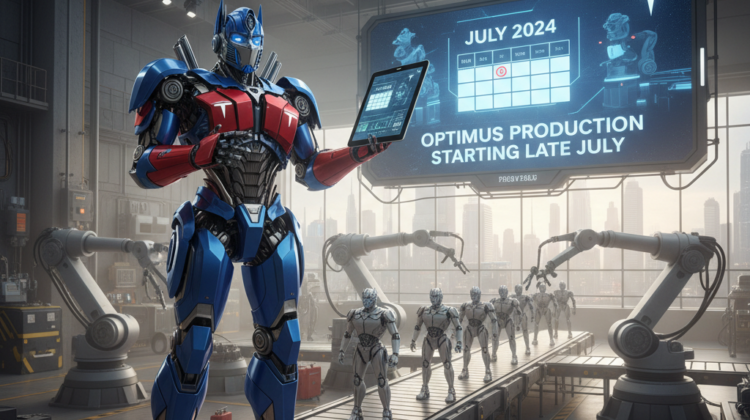
Elon Musk didn’t just drop a vague “sometime this year” on Optimus—during Tesla’s Q1 2026 earnings call he tied production to a specific factory reality. The plan: start Optimus robot production at Fremont in late July or August, after the Model S/X line moves out in early May. That scheduling detail matters because it reveals Tesla’s actual constraint isn’t robot design—it’s factory conversion, staffing, and ramp discipline.
Factory constraints are setting the pace, not lab breakthroughs
Most robot roadmaps fail for a simple reason: production readiness is a supply-chain and tooling problem long before it’s a software problem. Musk’s timeline implicitly acknowledges this. The Model S/X line’s departure in early May creates the first clean runway for the next industrial chapter at Fremont. In late July or August, Optimus can begin rolling off the former line because the plant will have had roughly two-and-a-half to three months to retool, validate processes, and start building repeatable throughput.
There’s also a subtle but telling calibration in his messaging: he cautioned that initial output will be limited. That’s a classic “ramp first, promise later” stance—one that aligns with how industrial systems behave when you’re moving from prototypes and pilots into stable manufacturing runs. If Tesla were confident in volume immediately, it wouldn’t be emphasizing caution.
Optimus 3: the “S-curve” argument and what it implies about volumes
In March 2026, Musk signaled that Optimus 3 could begin production this summer—but only with very low initial volumes and a slow “S-curve” ramp. This framing is important: an S-curve doesn’t just mean slow; it means the early phase is fundamentally about learning—cycle time, defect rates, assembly yield, and field reliability. With robots, “learning” isn’t abstract. A slight mismatch in actuator behavior, calibration steps, or sensor alignment can create large quality losses if you scale too quickly.
He also pointed to higher-volume production around summer next year, implying that the July–August window is for proof and process stabilization, not mass distribution. In other words, Tesla is treating Optimus like a new car program where the first months validate the factory and the subsequent months expand capacity once performance and yield become predictable.
RobotsBeat’s May 2026 reporting adds a strategic wrinkle: Tesla intends to unveil Optimus V3 closer to the production start date, targeting a July–August window as well. The “closer to production” approach can be read as risk management. It reduces the chance of unveiling capabilities that look impressive in demos but require months of manufacturing iteration to replicate reliably.
Why Tesla is timing the unveil to outpace competitors’ marketing—without overpromising
Competitors have increasingly tried to win attention by “showing frames” rather than shipping full systems—broadcasting progress while quietly fighting integration problems. Musk’s reported shift to bring the Optimus V3 unveil closer to production suggests Tesla wants the public narrative to align more tightly with measurable output. If competitors perform frame-by-frame progress updates, Tesla’s counter is straightforward: don’t just show hardware—show that hardware is about to be manufactured.
This also changes how investors and buyers interpret Tesla’s claims. When production timing is anchored to a factory conversion milestone—Model S/X leaving early May, Optimus starting late July or August—the story becomes less about speculative breakthroughs and more about operational execution. That’s a different kind of credibility: fewer “future tense” statements, more near-term manufacturing commitments.
Actionable signals to watch: yield, cycle time, and the first “real” deployment economics
The next phase for Optimus won’t be judged by announcements alone. The real signals will show up in three measurable areas during the initial Fremont production window: (1) output levels versus ramp assumptions, (2) assembly cycle time stability, and (3) reliability in repeat deployments. Musk’s insistence on caution and an S-curve ramp implies Tesla will prioritize yield learning before it chases headline volume.
For stakeholders trying to forecast whether Optimus can move from niche deployments to economically compelling automation, the critical question is when the ramp stops being a factory learning curve and becomes a capacity scaling curve. Musk’s indication that higher-volume production may land around summer next year suggests that Tesla expects a meaningful transition between those phases—likely when defect rates stabilize and calibration overhead drops enough to make unit economics coherent.
Practical takeaway: anyone planning around Optimus timelines should treat late July–August as a manufacturing validation phase, not a mass-market moment. Then watch whether Tesla actually accelerates the S-curve as implied for around summer next year. If it does, Fremont won’t just be producing robots—it will be proving that a general-purpose humanoid can be industrialized with the repeatability required for broad adoption.
Key takeaways: Tesla is pegging Optimus production to a late-July or August start at Fremont after early-May Model S/X line transitions, signaling that manufacturing readiness is driving the timetable. Musk’s “S-curve” language points to low initial volumes and a slow ramp, with higher-volume production targeted for roughly summer next year. The planned July–August proximity of the Optimus V3 unveil to production further suggests Tesla intends to align marketing with measurable output rather than prototypes.