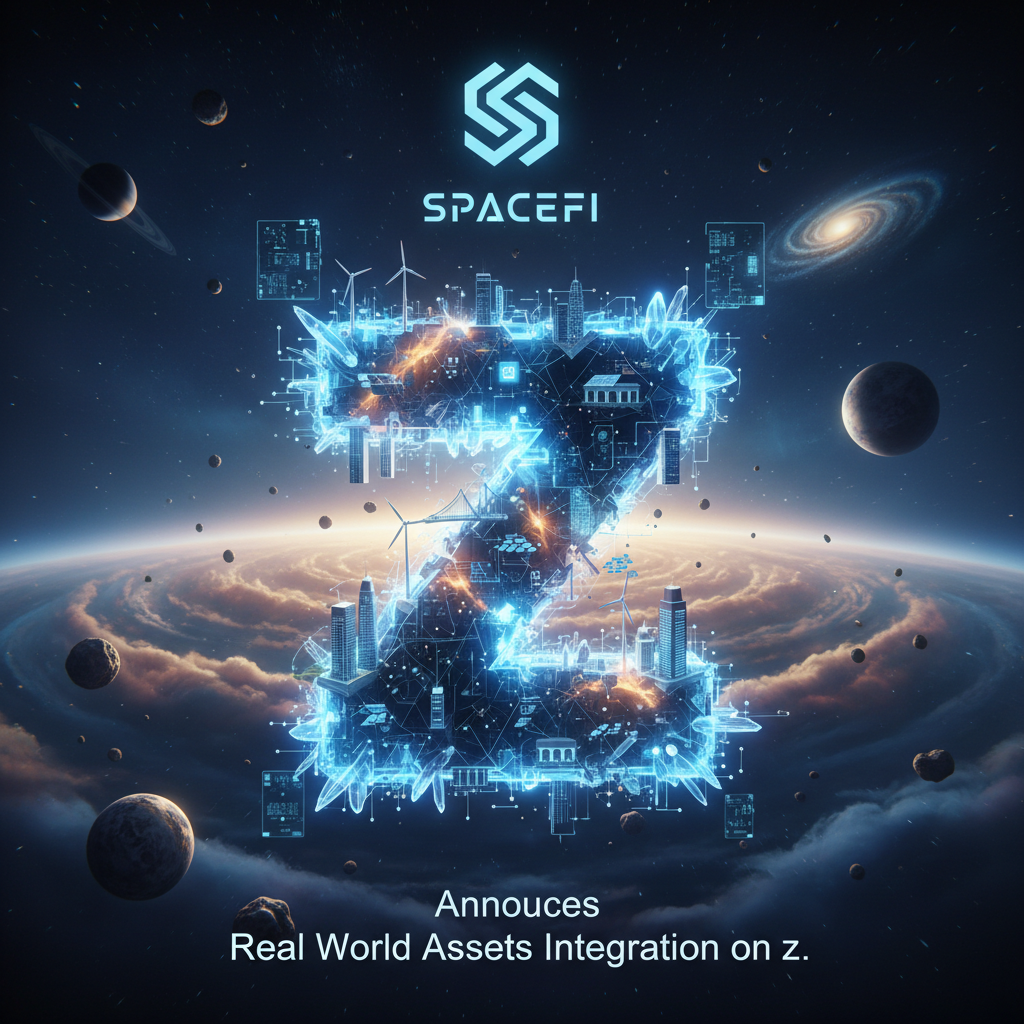
The most consequential shift in SpaceFi isn’t a new UI screen—it’s where the platform wants to place “real world” value. In January 2025, SpaceFi announced an integration to bring Real World Assets (RWA) onto zkSync Era, signaling a deliberate move from “crypto-native DeFi hub” toward “tokenization rail” for traditional asset classes.
That single direction clarifies why SpaceFi’s product decisions over the last year have felt incremental but coordinated. A migration to “SpaceFi 2.0,” the introduction of STAR (exchanged 1:1 with SPACE), and a broader ecosystem framing—DEX + NFT + Spacebase + Launchpad on zkSync Era—point to one strategy: make the chain and the user journey matter more than any single dApp.
From SpaceFi 1.0 to 2.0: what the STAR token swap says about incentives
SpaceFi’s March 25, 2024 update describing the migration from 1.0 to 2.0 is notable not because of what changed in the interface, but because of how incentives were redesigned. The new token, STAR, was introduced with an exchange ratio of 1:1 for SPACE, which is often how teams aim to reduce user friction while still resetting the token economy for a new phase of the product.
Token swaps at a 1:1 ratio typically indicate the team wants continuity of value perception while changing the mechanics under the hood—such as reward schedules, emissions logic, or how users move between “earning” and “participating” features. The update also emphasized UI/product improvements and described changes in how rewards/incentives transition during the move, which matters because DeFi users don’t tolerate ambiguity for long. If the incentive runway isn’t clear, liquidity becomes flighty.
In practice, this kind of migration often functions like a “platform reset”: the company can re-benchmark performance metrics, simplify smart-contract interactions, and align governance or reward flows to the next ecosystem narrative. SpaceFi’s narrative shift becomes more believable when you pair that 2024 migration with the 2025 RWA-on-zkSync plan—because RWAs are far more sensitive to user trust and operational clarity than a purely speculative yield loop.
zkSync Era as the distribution engine: why an L2 matters for a DeFi hub
SpaceFi positions itself as a DeFi hub on zkSync Era, combining DEX, NFT, Spacebase, and a Launchpad under one ecosystem umbrella. That structure isn’t just branding; it’s a distribution strategy. On an L2 like zkSync Era, the economics of trading, minting, and participation can be materially different from a high-fee environment—making it easier for users to interact frequently rather than “wait until gas is favorable.”
The Link3 project description reinforces that bundling: a single portal for DEX + NFT + Spacebase + Launchpad is designed to turn passive users into repeat participants. NFTs and launchpads also function as attention magnets, while a DEX functions as the liquidity sink. If the DEX is where assets consolidate and the Launchpad is where momentum is created, the NFT layer often supplies the community identity and incentive hooks that keep users returning.
What’s strategically interesting is how this ecosystem model supports the RWA integration planned for early 2025. RWAs typically require stronger compliance narratives, clearer custody/issuance pathways, and more careful risk framing. In that context, having an established “hub” with multiple engagement surfaces can reduce the barrier to adoption: users can learn the tokenization story through smaller, familiar interactions before they ever encounter an RWA token.
Real World Assets on zkSync: the product problem SpaceFi is trying to solve
SpaceFi’s January 20, 2025 announcement about integrating Real World Assets onto zkSync Era is framed as an early-2025 rollout meant to expand its DeFi ecosystem and enable traditional asset tokenization. This is a big claim because tokenization isn’t a single smart-contract feature—it’s a whole workflow: issuance, transfer, redemption logic, and a trust model that users can understand.
Bringing RWAs to a public L2 could help address one of the biggest adoption barriers for traditional assets: accessibility. Tokenization can, in theory, allow fractional exposure and faster settlement than typical settlement windows. But for users, the critical question is not whether tokenization is possible—it’s whether the platform makes the risk legible and the operational path predictable.
SpaceFi’s earlier migration work becomes relevant here. A migration that resets incentives and improves the UI isn’t just cosmetic when you plan to onboard RWAs. If STAR’s incentive transition mechanics (described in the 2024 SpaceFi 2.0 update) were built to reduce confusion and stabilize participation, then the RWA integration is likely intended to ride on that improved onboarding and reward clarity.
Another subtle point: RWAs can attract different liquidity profiles than pure crypto assets. Instead of chasing short-lived yield cycles, RWA participants often value steadier settlement and more transparent asset representations. A hub with DEX infrastructure can provide immediate trading venues, but it also raises the need for governance and risk monitoring—areas where tokenized ecosystems often lean on a native token and coordinated community participation.
Launchpad + NFT + DEX: why SpaceFi’s ecosystem layout is built for momentum
SpaceFi’s ecosystem design—DEX, NFT, Spacebase, and Launchpad—implies a specific growth loop. New assets and communities tend to emerge through NFTs and launchpads; traders then flow into the DEX; and recurring engagement can be supported through Spacebase-like primitives that keep users interacting between launches.
Link3’s SpaceFi page also references ongoing campaigns and updates, including Scroll-related and “SpaceFi 2.0” items. Even without getting lost in the specific campaign mechanics, the important insight is that SpaceFi is treating the platform as a moving product rather than a one-off DeFi protocol. In L2 DeFi markets, that posture matters: ecosystems that fail to iterate often become static liquidity pools, while those that continuously refresh user pathways can maintain higher retention.
The RWA integration could amplify that momentum. RWA narratives typically arrive in waves—each wave brings new attention, new participants, and a demand for on-chain liquidity. If SpaceFi can channel that attention through its hub model, it may avoid a common failure mode where tokenization launches with hype but lacks sustained trading depth or user education.
Still, the success criteria are concrete. SpaceFi will need to demonstrate not just that RWA tokens can exist on zkSync Era, but that transfers behave predictably, custody/issuer relationships are credible, and incentives don’t distort pricing in harmful ways. If those pieces align, SpaceFi’s hub approach could make it one of the more practical “RWA gateways,” not merely another dashboard claiming tokenization.
Actionable takeaways: what to watch next
If you’re evaluating SpaceFi as an ecosystem—whether as a user, liquidity provider, or long-term participant—watch three things as the early-2025 RWA rollout approaches. First, how STAR incentives evolve around tokenized assets: the 1:1 SPACE-to-STAR exchange suggests the team is capable of migration discipline, but RWA markets demand additional transparency and risk labeling.
Second, monitor whether the DEX layer on zkSync Era provides real liquidity for new token categories, not just volume. A hub can look busy while still failing to offer tight spreads and dependable execution, which matters more for assets that users expect to hold longer than a typical memecoin cycle.
Third, pay attention to the onboarding experience—SpaceFi’s 2.0 UI/product improvements matter because RWAs can’t be explained with the same blunt simplicity as speculative DeFi. The platforms that win in tokenization are the ones that make trade-offs understandable in plain language, with predictable operational outcomes.
SpaceFi’s trajectory—2.0 migration in 2024, STAR token restructuring with a 1:1 exchange, and an RWA-on-zkSync integration announced in January 2025—reads like a plan to turn zkSync Era into a broader value network. The next test is execution: can the hub translate tokenization hype into durable liquidity, clear user pathways, and an incentive model that doesn’t break when the asset class changes?