Apple is turning the Macs people already own into private AI servers. The app is called Claris Harbor. It runs open-weight models locally on Apple silicon, and it can pool several Macs over Thunderbolt 5 into one inference machine. Claris, the Apple subsidiary behind FileMaker, opened a private preview with an early-access sign-up page this week.
The details come from an App Store listing that leaker Aaron Perris posted on November 10. Apple removed the listing the same day. The product copy, the Claris sign-up page, and reports from 9to5Mac, MacRumors, and AppleInsider all describe the same app.
Harbor runs open-weight models with data staying on the Mac
The Claris early-access page says Harbor "turns the Apple silicon computers you own into a private AI server." Models run on the local hardware. "Data and prompts stay strictly within your physical Mac hardware," the page adds. Users browse, download, and load open-weight models from inside the app. Harbor handles the model management.
The pricing line is the sharp part. Zero cloud fees, no per-token billing. One day earlier Apple started selling $49.99 intelligence usage packs for its own cloud-backed AI features. Harbor points the opposite way. The cost is the hardware on your desk. (See also: Apple's first paid AI add-on, the $49.99 intelligence usage packs.)
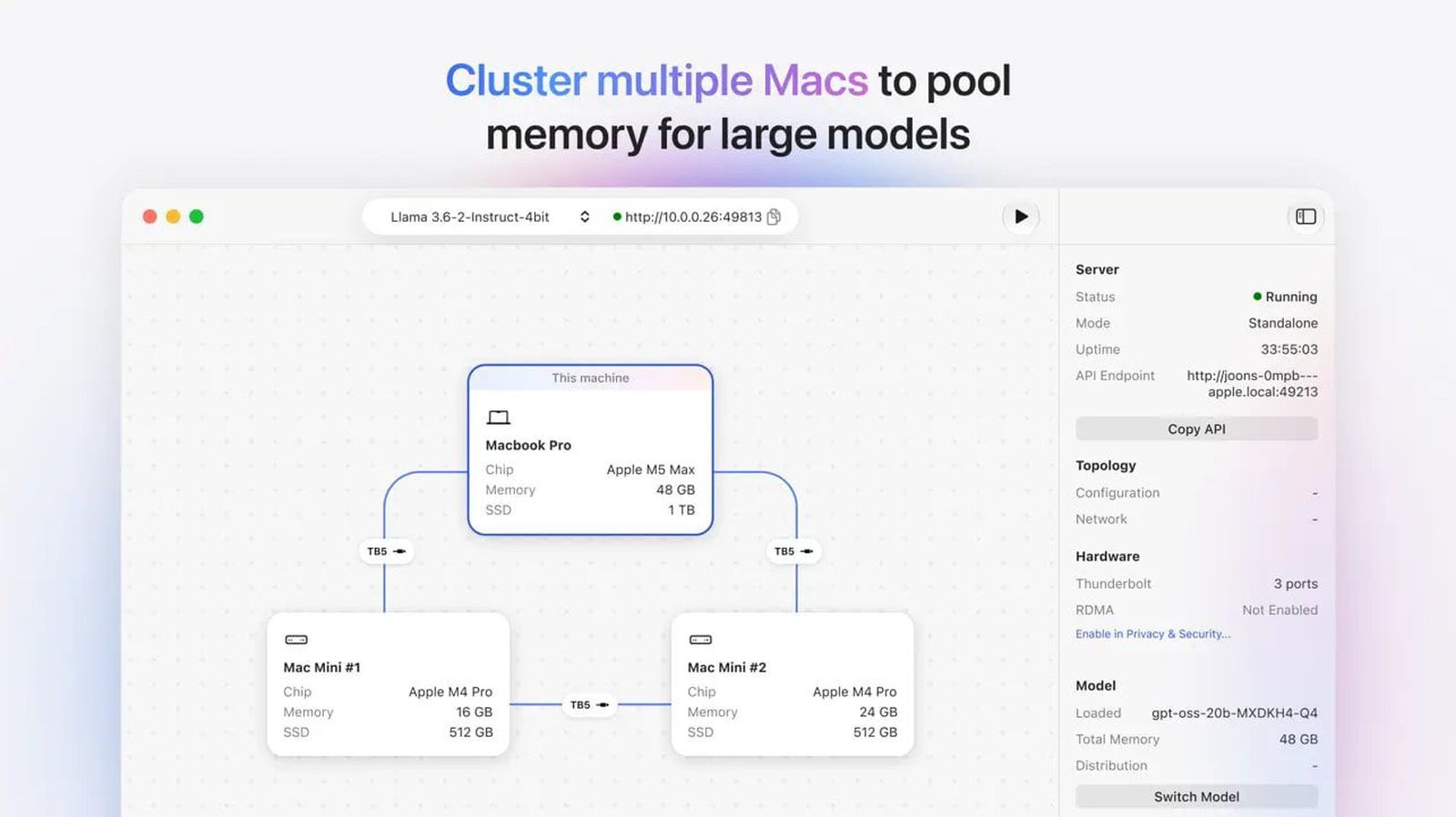
Harbor pools unified memory across Macs over Thunderbolt 5
On a single Mac, Harbor sets up an endpoint in minutes. For larger models, connect two or more Thunderbolt 5 Macs. Harbor pools their unified memory into a single inference resource, so a model can exceed what one computer fits in memory, or the cluster can serve more concurrent requests. MacRumors notes Apple added RDMA over Thunderbolt 5 in macOS Tahoe 26.2, which speeds up exactly this kind of machine-to-machine memory access.
Setup promises to be boring on purpose. The leaked copy says Harbor detects devices over Thunderbolt 5 automatically. "No manual configuration, no command line, no infrastructure expertise required." Mac users who want a local AI server today assemble it themselves, from a menu-bar MLX inference server like oMLX to a local model served as an OpenAI-compatible API, plus tools like the Ollama local-only mode that keeps prompts on the Mac.
How Harbor compares to Exo, LM Studio and MLX clustering
None of the underlying idea is new. Exo, the open-source tool, already clusters Macs. LM Studio already makes single-Mac local models easy. MLX-based Thunderbolt clustering exists in developer tooling, and Apple showed its own Minions system in October 2026. What Harbor adds is packaging. Same job, no terminal. AppleInsider reads the app as aimed at easier setup rather than raw performance, and that matches the leaked copy.
One tradeoff matters here. Harbor is a private preview from Claris, a brand that mostly sells FileMaker to businesses, and the sign-up form asks for a company name. Pricing is unannounced. Free is not guaranteed, even with zero token billing.
Private preview under Claris, App Store listing removed
Perris posted the product copy on November 10 at 18:56 UTC and confirmed the app was previously named Fabric. A download path still showed com.claris.fabric. At 23:40 UTC he reported Apple had taken Harbor off the App Store. The Claris early-access form remains up. AppleInsider writes that end users should not expect the app anytime soon. 9to5Mac expects a public launch in the weeks or months ahead. Apple itself has announced nothing. No date, no price, no system requirements yet.
Photo: Claris / MacRumors
Source: Claris early-access page, Aaron Perris on X, 9to5Mac, MacRumors, AppleInsider