It has been reported as supply chain related information that TSMC will start trial production in 2027 on the 1.4nm process, which is the next step in the latest 2nm process used to manufacture the A20 Pro and M6.
The A22 Pro (tentative name), which is manufactured using a 1.4nm process, is expected to be installed in the 2028 full-screen iPhone and iPhone Duo 3.
1.4nm process manufacturing plan
The following plans are currently being reported for semiconductor manufacturing using TSMC’s 1.4nm process.
- Around April 2027: Start of small-scale trial production
- Information that aims to start mass production in the second half of 2027
- Around April 2028: Expand manufacturing scale with expanded factory
However, there are other predictions for the start of mass production in mid-2028, which may change depending on the status of future factory construction and production line launches.
The first Apple silicon could be the M series
If mass production using the 1.4nm process begins in the second half of 2027, it is possible that the M7 Pro, M7 Max, M7 Ultra, etc. will be the first Apple silicon.
The A series was ahead of the most advanced processes up to the 3nm generation, but in the 2nm generation, the M6 was commercialized before the A20 Pro.
There were also reports that the reason for moving the M6 ahead of time was to adjust the manufacturing process with a relatively small number of chips shipped, and to increase the yield rate by the time mass production of the A20 Pro begins.
If the same idea is adopted for the 1.4nm process, it is possible to begin mass production with the M series and then expand to the A22 Pro.
Will production increase in 2028 be for A22 Pro?
If the manufacturing scale of the 1.4nm process is expanded in the spring of 2028, it will be convenient for mass production of the A22 Pro for the next generation iPhone, which will be released in the fall of the same year.
The 2028 model is expected to be the iPhone 20 Pro or iPhone 21 Pro series, and it is rumored that the iPhone Duo 3 will also be released around the same time.
If these models are equipped with the A22 Pro, TSMC’s factory expansion plan also fits in with Apple’s product roadmap.
How to view upfront investment in anticipation of Intel’s entry
It has also been reported that Intel may be responsible for manufacturing some Apple silicon in the future.
If Intel starts manufacturing chips for the base models of the A series and M series, TSMC may concentrate its cutting-edge processes on the higher-performance Pro, Max, and Ultra.
In light of this situation, it seems possible that TSMC is rushing to launch next-generation processes, including 1.4nm.
Rumor has it that full-screen iPhones will be available in 2028
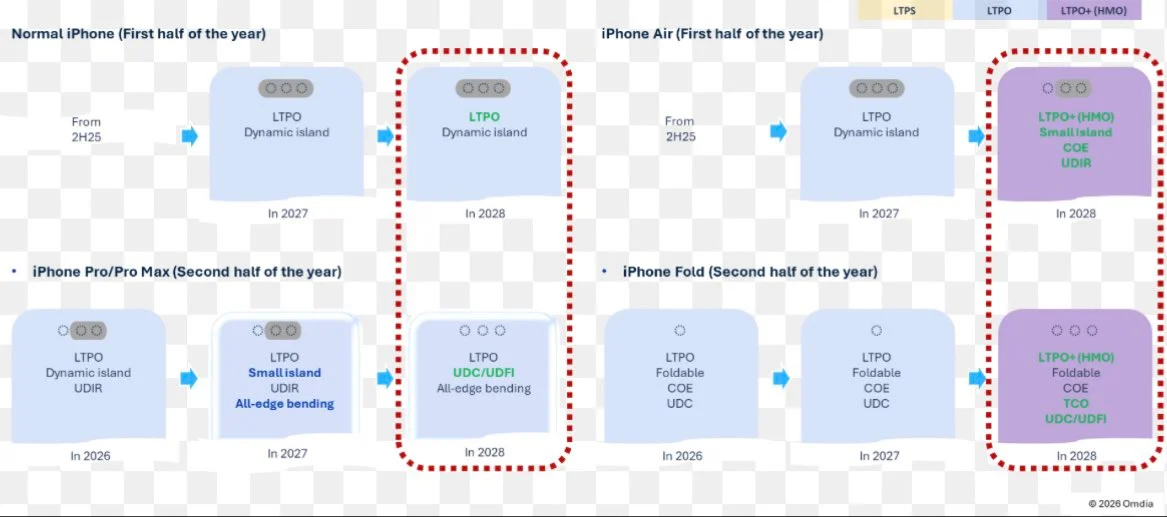
The 2028 iPhone model may have a full screen without any cutouts or punch holes on the display.
In the iPhone 18 Pro series, part of the Face ID mechanism is placed below the display, making the Dynamic Island smaller.
Furthermore, the iPhone Duo uses a FaceTime camera embedded under the screen on the main display, and Apple has already commercialized related technology.
If these technologies can be developed and both Face ID and the front camera can be placed below the display, it is expected that a full screen can be achieved even on a straight iPhone.
Will iPhone Duo 3 be larger and have three cameras?
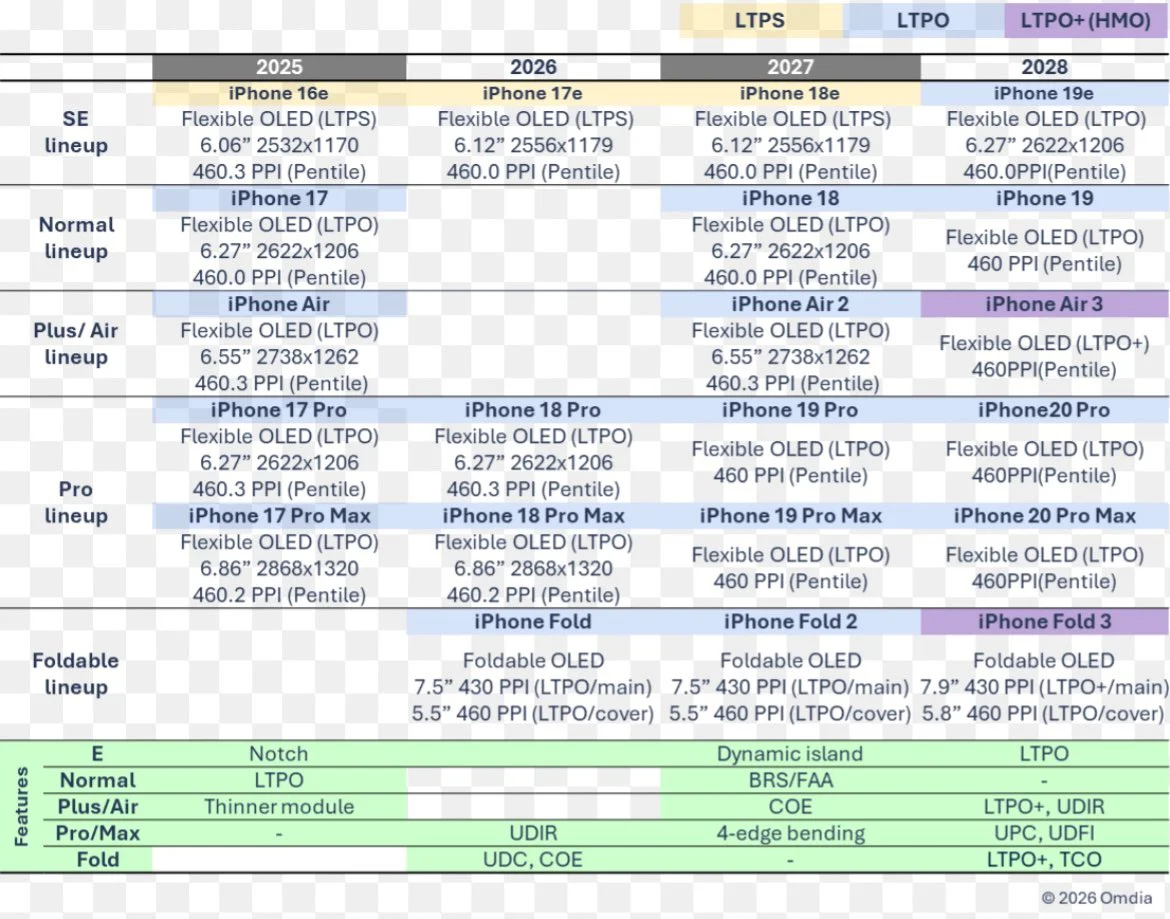
iPhone Duo currently has a 7.6-inch main display and a 5.4-inch outer display.
It is expected that the display size of the third generation iPhone Duo 3 will increase, and the space inside the device will also increase accordingly.
If there is more space inside, we can expect to see features such as a telephoto camera, LiDAR scanner, and action button that were missed on the original iPhone Duo.
In addition to the improved processing performance of the A22 Pro, we are also interested in the possibility that the 2028 model will add functions that were omitted in the original iPhone Duo.
Photo: Saurav (@Saurav_DJ47)/X, Harsh Patel (@mHp21)/X
Source: iPhone Mania