Information from the display-related industry has revealed that Samsung Display plans to increase production of organic EL (OLED) displays for iPads and foldable iPhones.
The company is expected to manufacture OLEDs for the new iPad mini, new iPad Air, and foldable iPhone, and it is thought that production will be increased in response to the increase in shipments of these units.
OLED shipments for Apple will increase significantly
Samsung Display’s shipments of OLED displays for Apple’s new products are expected to increase from approximately 10 million units in 2026 to approximately 24 million units in 2027.
Specifically, sales for iPads are expected to increase significantly from approximately 2 million sheets to approximately 9 million sheets, and sales for foldable iPhones from approximately 8 million sheets to approximately 15 million sheets.
Approximately 150 million pieces for straight iPhone
This approximately 24 million units do not include OLED displays for straight iPhones. Approximately 144 million units are expected to be shipped in 2026 alone.
It is predicted that sales will increase to approximately 148 million copies by 2027, and approximately 24 million copies for iPads and foldable iPhones are equivalent to approximately 16% of that number.
Is the OLED conversion of iPad mini and Air having an impact?
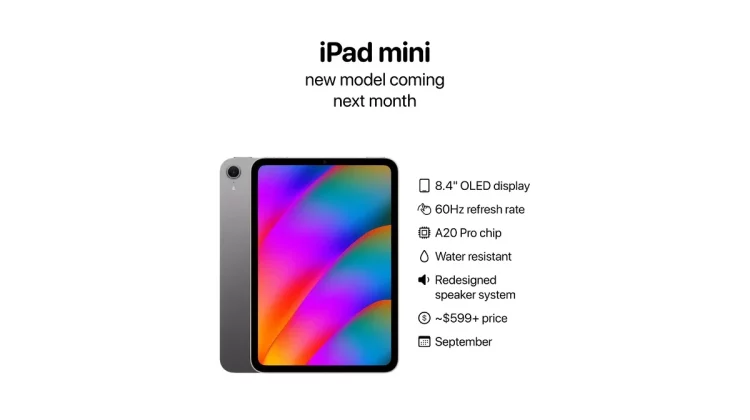
The number of OLED shipments for iPad in 2026 is thought to include supply for the new iPad mini, which is rumored to be announced in October 2026, in addition to the supply for iPad Pro.
The total shipment volume in 2026 is approximately 2 million units, which is predicted to increase to approximately 9 million units in 2027.
The reason for the increase is thought to be that in addition to the new iPad mini being sold throughout the year, the iPad Air will also be equipped with an OLED display.
The new iPad mini and iPad Air are expected to use a single-stack OLED with one light-emitting layer, which will differentiate them from the iPad Pro, which has a two-layer tandem OLED.
Single stack OLED is expected to have a lower unit price than iPad Pro, but iPad Air is expected to ship in higher numbers than iPad Pro, so we can expect an increase in transaction value.
For Samsung Display, the expansion of OLED adoption in iPad mini and iPad Air is likely to be a factor in significantly growing its display business for Apple.
Sales for foldable iPhones will increase significantly
The number of OLED displays for foldable iPhones is expected to increase from approximately 8 million in 2026 to approximately 15 million in 2027.
In addition to continued supply for the first-generation model, the 2027 supply is thought to include displays for the second-generation model, which is rumored to be announced in the fall of the same year.
Both the first-generation and second-generation foldable iPhone models are rumored to have a 7.7-inch main display and a 5.5-inch sub-display.
Will the OLED material be changed to M16 in the second generation?
There was information that the main display of the first generation folding iPhone will be made of OLED material “M14”, which is the same generation as the iPhone 17 Pro series.
The second-generation model maintains the same display size while switching to newer OLED materials, which can be expected to improve brightness, power efficiency, and lifespan.
There are rumors that the new generation OLED material “M16” will be adopted quickly for the iPhone 18 Pro series, so there is a possibility that this technology will be applied to the second generation foldable iPhone.
Will it expand to 7.9 inches/5.8 inches in 2028?
The third generation model, which is rumored to be released in 2028, is expected to have a main display of approximately 7.9 inches and a sub display of approximately 5.8 inches.
There are also reports that Samsung Display has signed a contract with Apple to exclusively supply OLED for foldable iPhones for three years, and may be responsible for supplying up to the third generation.
Photo: Apple Hub/Facebook
Source: iPhone Mania