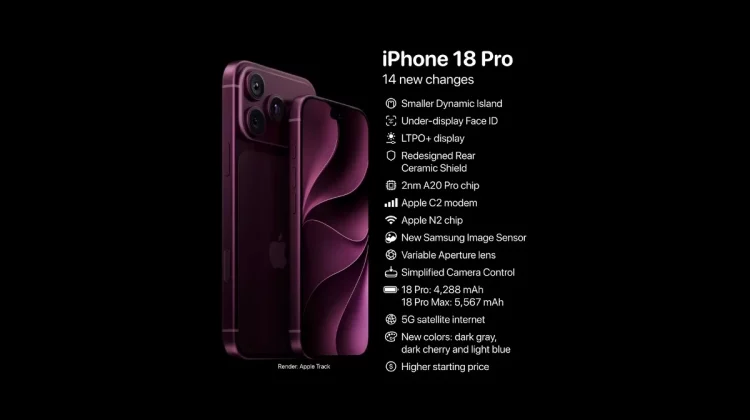
It is certain that the A20 Pro, which is expected to be installed in the iPhone 18 Pro series and foldable iPhone, will be manufactured using TSMC’s 2nm process “N2”, just like the M6.
With reference to the performance improvement rate and architecture of the M6 that have already been announced, we will consider how the A20 Pro may evolve from the A19 Pro.
M6 goes to 2nm before A20 Pro
Up until now, Apple silicon manufactured using TSMC’s latest process has been first used in the A series of iPhones, followed by the M series.
However, this time, the M6 adopted the 2nm process first, and it was installed in the new Mac mini. The A20 Pro is expected to be Apple’s next 2nm chip.
There is a view that the reason why the M6 took the lead is that the mass production process for the N2 was optimized with the M6, which was produced in relatively small quantities, and then the mass production of the A20 Pro was moved on.
If this speculation is correct, we may be able to predict the direction of the A20 Pro’s evolution to some extent from the improvements of the M6, which is located in the same generation.
2nm technology improves performance and power efficiency
The biggest change in the A20 Pro is the miniaturization from the 3nm process “N3P” used in the A19 Pro to the 2nm process “N2”.
It is predicted that the A20 Pro will have up to 18% higher processing performance than the A19 Pro, or if it has the same performance, it can reduce power consumption by up to 30%.
It would be natural to think that actual products would be designed to balance both, rather than focusing on either performance improvement or power saving.
The vapor chamber is also expected to be improved in the iPhone 18 Pro series, and it is expected that the improved cooling performance will be used to bring out sustained high performance.
Will the Neural Engine be significantly strengthened?
The most significant change in the M6 is its AI processing performance, which is the first Apple silicon to be equipped with a dual 16-core Neural Engine.
By increasing the conventional 16-core Neural Engine to two, M6 has achieved up to twice the Neural Engine performance compared to the previous generation. It has been pointed out that the A20 Pro may also have a dual 16-core configuration.
There is analysis that the area allocated to the Neural Engine has become larger in the leaked images of the A20 Pro’s internal structure. If this happens, it seems likely that the A20 Pro will have significantly enhanced on-device AI processing.
Even when combined with 12GB of unified memory (the same capacity as the A19 Pro), it will also be advantageous in processing large models used with Apple Intelligence and Siri AI.
Especially enhanced AI performance
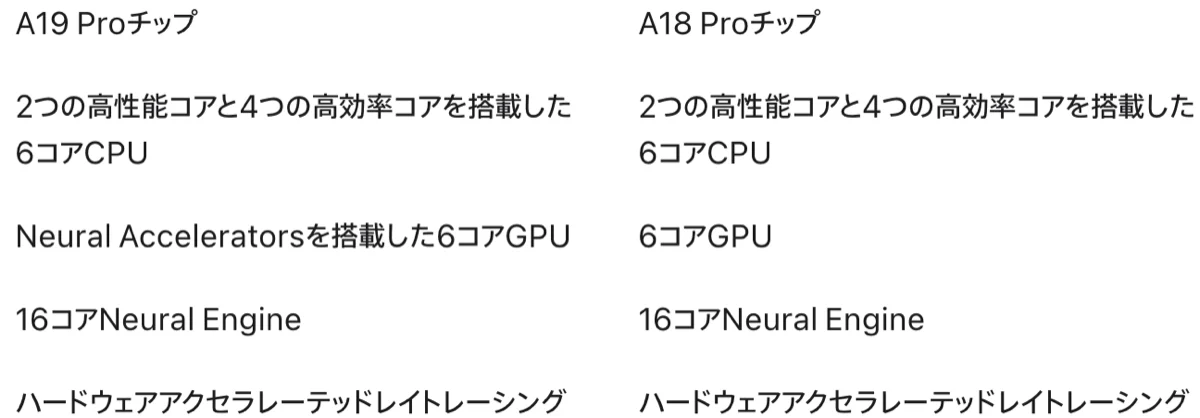
Like the M5, the A19 Pro has significantly increased AI calculation performance by adopting Neural Accelerator for each GPU core for the first time, but considering the improvements in the M6, the A20 Pro will not have the same scale of improvements.
It is believed that the A20 Pro will focus on steadily improving performance to the second generation of Neural Accelerator.
Expected to enhance graphics with 7-core GPU
It has recently been predicted that the A20 Pro’s GPU will have a seven-core configuration, an increase of one core from the A19 Pro’s six cores.
The number of GPU cores alone will increase by approximately 17%, so if you combine this with improvements in architecture and operating frequency, you can expect an improvement in graphics performance.
The M6 has improved shader core and Dynamic Caching, as well as improved geometry performance, and similar improvements may be reflected in the same generation A20 Pro.
Hardware-accelerated ray tracing is already supported on the A19 Pro, so the A20 Pro is notable for its improved processing performance and efficiency.
Memory bandwidth can be significantly improved
The M6’s maximum memory bandwidth is 170GB/s, an improvement of about 11% from the M5’s 153GB/s. The A20 Pro is also expected to have increased memory bandwidth.
A recently posted A20 Pro design drawing analyzes that the memory interface for LPDDR5X DRAM will be expanded from 64 bits to 96 bits.
Even assuming the same memory transfer speed, going from 64 bits to 96 bits increases theoretical bandwidth by 50%.
Therefore, it is possible to achieve higher bandwidth than the A19 Pro’s 76.8GB/s, which is approximately 11% more than the 85.3GB/s.
Improving memory bandwidth is not only beneficial for GPUs, but also for Neural Engines and on-device AI models when processing large amounts of data.
It is important to be able to experience AI performance
A20 Pro is expected to have multiple improvements related to AI processing, including 2nm technology, enhanced Neural Engine, 7-core GPU, and increased memory bandwidth.
However, simply improving the chip’s computational performance does not necessarily mean that users will experience the evolution of Apple Intelligence.
It will be important to see to what extent the A20 Pro’s performance can be utilized by iOS27 and the updated version of Siri to increase response speed, on-device processing, and available AI functions.
Even in the AI feature competition with the Google Pixel and Galaxy series, it seems that the actual functions and usability will influence the evaluation rather than benchmark performance.
Expected to expand to new iPad mini etc.
In addition to the iPhone 18 Pro series and foldable iPhone, the A20 Pro may be deployed in future Apple products.
It is rumored that it will be installed in the new iPad mini and future MacBook Neo, and if realized, it will be used in a wide range of products as a chip that emphasizes Apple Intelligence.
Photo: Apple Hub/Facebook, Apple (1), (2)
Source: iPhone Mania