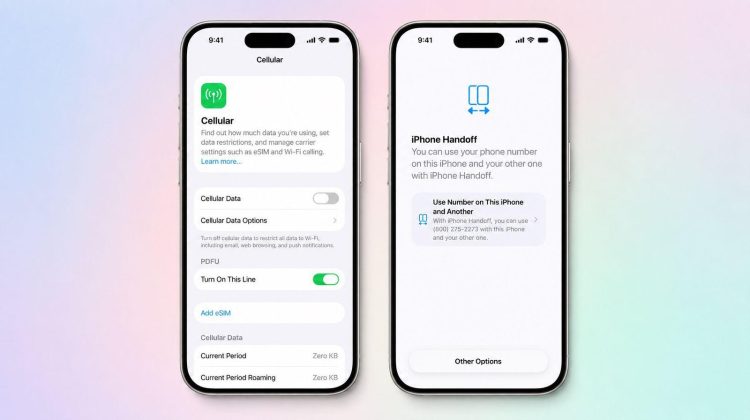
When Apple released iOS 27 at WWDC26, there were so many new features that some were almost ignored. One of them is the so-called iPhone Handoff, a feature designed to solve the hassle of frequently changing SIM cards when using the same number on two phones. Now, on the eve of the official release of the system, a demonstration video circulating on professional forums has been leaked, revealing its specific working principle.
The idea isn’t new: Apple mentioned it briefly during its keynote, but didn’t elaborate. There are indications that this is just a simple improvement on existing functionality. Handover of tasks between devices But in reality, it does much more than that. iPhone Handoff allows you to use the same active phone number on two iPhones, so you can easily switch between the two phones without missing any calls or texts. The question is: How did he do it?
How iPhone Handoff Works

This configuration is reportedly done via cellular data settings. There, you’ll find a new option to choose which device serves as the primary iPhone and which serves as the secondary iPhone. The primary device retains the original eSIM card, while the secondary device is used to receive calls. Although complementary eSIMs are bound to the same number, don’t expect both lines to be active at the same time: Apple’s Quick Switch system sets two states: active and passive. Only one line is active at any time, and when one line switches, the other line becomes the line to receive incoming calls.
The demo was conducted using the Xcode 27 simulator, and the entire process turned out to be very intuitive. The test demonstrates how to select the primary iPhone from the Cellular Data menu and how the system automatically generates a secondary eSIM card. However, it is important to note that this is only a development version. It may undergo some modifications before final release. The fact that the feature isn’t available yet in the current beta setup suggests Apple is waiting for carriers to be ready.
Requirements and compatibility with carriers
Not everyone can use this feature. In addition to requiring two iPhones to be upgraded to iOS 27, carriers must also approve it. And here’s the old problem: Telcos generally frown upon duplicating SIM cards. According to the information collected, T-Mobile in the United States and Deutsche Telekom in Germany will be the first to provide compatibility, but there has been no official confirmation yet. In Spain we can only wait for the operators to join.
This requirement is crucial as the feature will not work without carrier activation of the additional eSIM. Additionally, additional charges may apply as the second device requires specific registration. It’s unclear whether there will be additional costs, and Apple hasn’t disclosed any information. But one thing is for sure…it’s not the same as traditional multi-SIM cards. Some carriers allow multiple devices to connect simultaneously. But in this case, only one device is service active at any time.
The practical uses and differences of dual-SIM dual standby
What’s the use? Imagine you have a personal iPhone and a business iPhone. With the iPhone relay function, you don’t need to carry two numbers or change SIM cards frequently. All you have to do is decide which phone will be your main phone and which one will be your backup. This feature is also useful if you sometimes use a larger foldable screen iPhone, sometimes use a classic iPhone, or if you want to give your old iPhone a new lease of life as a backup for travel or outdoor activities. Here’s the kicker… You’ll always see the same number on your currently activated device. .
It should be noted that this is different from the existing dual-SIM dual-standby system. Dual SIM allows one iPhone to be used with two different numbers. iPhone relay allows two different iPhones to take turns using the same number. The two complement each other, but solve different problems. Dual SIM dual standby is still the best option for users who need to use two lines; and for those who want to share one number with two phones, iPhone relay is a much-needed solution.
It is still unknown whether Apple will eventually add this feature to iOS 27.0 or choose to wait for subsequent updates. We’ll find out soon, as the stable version is expected to be released the week of September 14th. In the meantime, we can only wait patiently to see if the carrier will provide support. One thing’s for sure… Mobility between devices continues to make important strides. This is probably one of the most useful new features of the new system.