
It was posted on the Chinese SNS Weibo that the A20 Pro, which is expected to be installed in the iPhone 18 Pro series and foldable iPhone, will be equipped with a 7-core GPU.
If this prediction comes true, it will increase by one core from the A19 Pro’s 6-core GPU, and further improvements in graphics performance are expected.
It also seems possible that we will be able to further screen out those that contain defective GPU cores and deploy 5-core GPU specifications and 6-core GPU specifications to the iPhone Air 2 and MacBook Neo 2.
Rumors about the main features of A20 Pro
The A20 Pro is expected to be manufactured using TSMC’s 2nm process “N2”, which will be miniaturized from the 3nm process “N3P” used for the A19 Pro.
According to the die configuration predictions posted this time, the following changes will be made to the A20 Pro.
- The CPU continues to have a 6-core configuration with 2 high-performance cores and 4 high-efficiency cores.
- Increased L2 cache of high efficiency core from 6MB to 8MB
- High-performance core L2 cache maintains 16MB
- Increased GPU from 6 cores to 7 cores
- Changed system-on-chip (SoC) and DRAM layout by adopting WMCM (Wafer-level Multi-Chip Module)
- Improving performance and power efficiency with 2nm
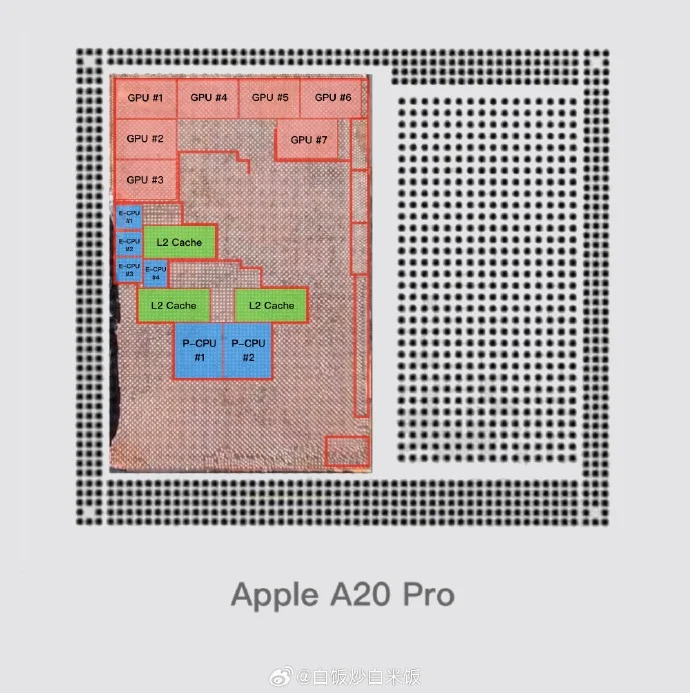
If a 7-core GPU is realized, the number of GPU cores will increase by about 17% compared to the A19 Pro. With the addition of architectural improvements, GPU performance is likely to increase even further.
If this is combined with an improvement in operating frequency, we can expect significant improvements in scores on GPU benchmarks such as Geekbench 6 Metal.
Will the CPU continue to have a 6-core configuration?
According to this information, the A20 Pro’s CPU is expected to have a 6-core configuration with 2 high-performance cores and 4 high-efficiency cores, just like the A19 Pro.
Other rumors include a 6-core configuration with 2 ultra-high performance cores, 2 high-performance cores, and 4 high-efficiency cores, but this is different.
Rather than increasing the number of CPU cores or changing the configuration, it seems that the plan is to improve processing performance by improving operating frequency and power efficiency by switching to 2nm, and expanding cache capacity.
Even in that case, you can expect an improvement from the A19 Pro in Geekbench 6 not only in single-core performance but also in multi-core scores.
Will there be room for additional GPUs with 2nm?
TSMC’s N2 has higher transistor density than N3P, so it is expected that more circuits can be mounted with the same die area.
If Apple allocates some of the increased transistors to GPU enhancement, it is possible to increase the GPU cores from 6 to 7 cores.
However, miniaturization of processes does not necessarily mean that the area occupied by CPUs and GPUs will be reduced. You can also use the extra headroom for other circuits.
It is also possible that it will be used to strengthen the cache, Neural Engine, ISP (Image Signal Processor), etc., so the direct relationship between 2nm and 7-core GPUs is speculation at this point.
Differentiate your product by disabling GPU cores?
If the A20 Pro is equipped with a 7-core GPU, future products that use the same chip may have specifications that disable some GPU cores.
For example, the following usages are possible:
- 7-core GPU: iPhone18 Pro series and foldable iPhone
- 6-core GPU: iPhone Air 2, etc.
- 5-core GPU: future MacBook Neo etc.
- Low operating frequency version: New iPad mini
Even if a manufactured chip has a problem with some GPU cores, the number of usable chips can be increased by disabling those cores and producing a product.
The so-called chip “binning” has the advantage of making it easier to deploy the same basic A20 Pro design into multiple products and different price points.
This is already the case with the iPhone Air.
The A19 Pro installed in the current iPhone 17 Pro series is a 6-core GPU, but the iPhone Air is equipped with the A19 Pro with 5-core GPU specifications.
Apple is already using the same A19 Pro with different numbers of GPU cores for each product. It is possible to use a similar method with the A20 Pro.
Regarding the MacBook Neo, the current model is equipped with the 5-core GPU A18 Pro, so there is a possibility that a model with two defective GPU cores that would be discarded now can be used for a new MacBook Neo series in the future.
A15 Bionic also has multiple specifications
Apple has a history of using chips with the same basic design in multiple products with different specifications such as the number of GPU cores.
In the A15 Bionic, the iPhone13 and iPhone13 mini were equipped with a 4-core GPU, and the iPhone13 Pro series was equipped with a 5-core GPU. The A15 Bionic with 5-core GPU specifications was also used in the iPad mini 6, but the CPU operating frequency was set lower than that for the iPhone.
Therefore, it is quite conceivable that the A20 Pro will have multiple specifications with a full 7-core GPU and some GPU cores disabled. However, there is currently no concrete information that the A20 Pro with 6-core GPU or 5-core GPU specifications will actually be commercialized.
We will have to wait for the official announcement regarding the actual GPU configuration and usage for each product, including the information that the A20 Pro will have a 7-core GPU.
Photo: White rice bowl via Wccftech, Apple Cycle (@theapplecycle)/X
Source: iPhone Mania