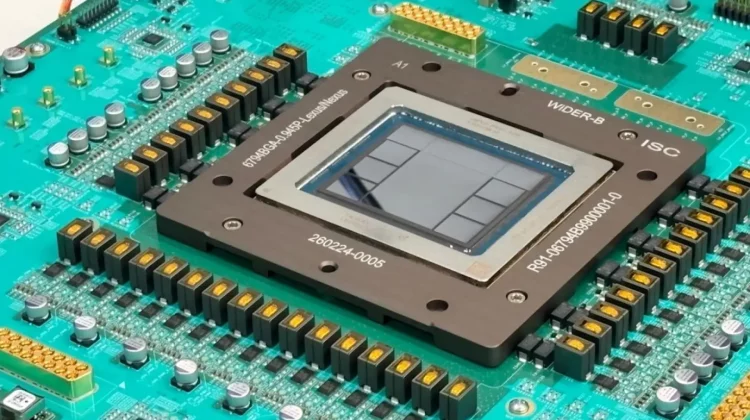
OpenAI has released the first performance data for its custom processor. The chip, developed in partnership with Broadcom Inc., claims it outperforms Nvidia’s systems at inference tasks: running pre-trained AI models to answer queries. The move is part of OpenAI’s strategy to reduce costs and dependence on large semiconductor manufacturers, and is a strategy that other large technology companies have adopted.
OpenAI’s strategic focus is on improving energy efficiency, one of the largest expenses in AI data centers. Jalapeño hopes to lower electricity bills while providing faster and cheaper service. For millions of users. Preliminary data released in the official statement show a significant improvement in performance compared to currently available processors, but these results still need to be verified in an actual production environment.
What are jalapeños? What is it used for?
Jalapeño is OpenAI’s first purpose-built processor, designed specifically for the inference phase: the stage where a pre-trained model receives requests and generates responses. It is not designed for the model training phase, which will remain an area where Nvidia will be critical to OpenAI. The chip was released in June this year and was developed in record time – only nine months, which is rare in the semiconductor industry.
During the design process, OpenAI used its own AI model to optimize and program the chip, which reflects how artificial intelligence accelerates its own infrastructure construction. Jalapeño is designed to support large language models (LLMs). And be compatible with various architectural ecosystems so that companies can deploy multiple generations of platforms.

Performance and efficiency: This is where it surpasses Nvidia.
In tests on models such as GPT-OSS 120B, DeepSeek R1 and Kimi K2.5 1T, Jalapeño’s AI productivity per watt was 1.5 to 1.9 times higher than Nvidia’s GB200 and GB300 architectures. The time required for system response (ie latency) is reduced by a factor of 1,7 to 3,6. The data comes from public benchmarks on the InferenceX platform and reflects a significant improvement in the balance between performance and power consumption.
The chip’s nominal power is 700 watts, but in internal testing, its sustained power consumption reached 550 watts. This number is particularly noteworthy considering that the power consumption of Nvidia GPUs can approach or even exceed 1.200 watts. For OpenAI, getting more done with fewer resources is critical because as its data centers and services scale, power costs have become one of the most difficult costs to control.
In the comparison conducted by OpenAI, the advantage is that Jalapeño is expanding its own models that it has not launched yet. This shows that the architecture is ready for larger and more complex models in the future. Even so, consulting firm SemiAnalysis pointed out that it remains to be seen whether the chip can maintain the performance of laboratory tests in an actual production environment.
OpenAI’s strategy and the global background of chips
OpenAI isn’t the only company deciding to design its own hardware. Google, Amazon, Microsoft, and Meta all already have custom accelerators: Google’s TPU, Amazon’s Trainium, Microsoft’s Maia, and Meta’s MTIA processor. Now, OpenAI has joined the ranks. Claude’s manufacturer, Anthropic, is also preparing to develop its own silicon chips. The race is to control the cost and availability of computing resources and the desire to no longer be dependent on a single vendor in the future.
For its part, OpenAI will not sell Jalapeño to a third party; it will remain within its own infrastructure, which will likely reduce the final cost of the service. However, the company maintains close ties with Nvidia, and the two parties have signed an agreement to build a large data center in Ohio. In addition to continuing to purchase accelerators for other tasks such as training, the relationship between the two is more complex than it appears, as they seek to reduce costs and increase efficiencies without abandoning traditional supply chains.
For Spain and Europe, this shift toward local chips means less reliance on imports and potentially lower prices for AI services used by local companies, although the hardware infrastructure remains concentrated in the United States and Asia.
Deployment plans and next generation
OpenAI expects to integrate the first Jalapeño processors into its infrastructure in the fourth quarter of 2026, with capacity expansion throughout 2027. It has been confirmed that: The design of the second-generation chip has entered the advanced stage. The chip tape-out work is expected to be completed in the next few months. The third generation product is also currently in the concept stage, indicating that this is a sustainable long-term project.
The company emphasized that Jalapeño’s goal is to provide lower latency to thousands of users, allowing for smoother AI processing and preventing the system from being overloaded when demand increases. The initial promotion scale is limited and will be gradually expanded later. At present, the production volume and final cost of the chip have not been announced.
Jalapeño has the potential to change the balance of power in the accelerator market. However, competition with Nvidia will ultimately determine its long-term success or failure. If this chip delivers on its promise, the cost of artificial intelligence will fall in the next few years, but it will take some time to know for sure.