I placed the iPhone 17 Pro in a housing that claims to be compatible with 20m and took photos and videos at depths of approximately 1m and 5 to 8m.
In shallow water, the fish and seabed were brightly photographed, and in deep water, the light shining from the water surface and the deep blue were impressive.
We will introduce this method based on live-action footage to see if it is a method suitable for people who want to save their summer memories directly to the iPhone they use without increasing the number of dedicated cameras.
Take pictures of the ocean without increasing the number of dedicated cameras
Even if you are interested in underwater photography, you may be wondering whether to buy an action camera or a compact digital camera for underwater photography just for that purpose. Considering the work involved in transferring data from the SD card after shooting, it seems a little exaggerated for a camera that is only used when traveling.
So this time, I put the iPhone 17 Pro that I usually use into a 20m compatible housing and took it underwater. This is not a project to test the water resistance of the device itself, but a live-action review to see what kind of images can be left behind through the housing.
Brightly record fish and the seabed at a depth of about 1m
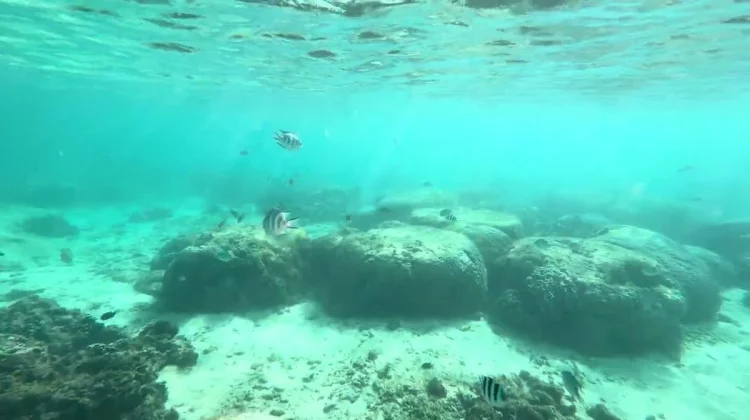
First of all, this is a video of a wide area of fish and rocks at a depth of about 1m.
Because it is close to the sea surface and the light easily reaches it, you can see the unevenness of the ocean floor and the outline of rocky areas. Even in the blue-tinged water, the fish were clearly visible, and the direction in which they were swimming and the sense of distance from their surroundings were also conveyed.
The beauty of video is that you can not only stop the video and check the details, but also keep the movement of the fish and the fluctuation of the water intact. I was able to bring back the sights I saw at the beach in the summer, along with movements that were close to my memories.
At a depth of about 5 to 8 meters, light and deep blue are the main characters.
The following is a video taken from a depth of about 5 to 8 meters, looking up at the water surface.
Since the subject and shooting direction are different from shallow water videos, it is not possible to compare the difference in image quality based only on water depth. On the other hand, the light coming in from the surface of the water, the air bubbles rising upward, and the blue that deepens toward the depths overlap, creating a different atmosphere than in shallow areas.
The housing is a product that claims to be compatible with 20m, but this time I was afraid to take it deeper than that, so I stopped shooting at a maximum depth of about 8m. You need to consider the water depth that the product is compatible with and the water depth that you actually tested it on separately.
You can immediately review the footage you shot on your iPhone
The advantage of shooting with an iPhone is that you don’t have to transfer the data after you get out of the water. Underwater photos and videos go into the same Photos app as other photos you take during your trip.
If you record to the SD card of a dedicated camera, it tends to remain untransferred to your computer or iPhone. With an iPhone, you can do everything from checking the shot immediately after shooting, editing unnecessary parts, and sharing it with family and friends.
Apart from the image quality, being able to keep summer memories in the same place as everyday photos was a big advantage. This ease of use will be suitable for people who don’t do underwater photography very often.
Things to check before taking it into the water
Please note that housings differ in compatible models, operating methods, and waterproof conditions depending on the product. Before heading into the ocean, check at least the following:
- Is it compatible with iPhone17 Pro?
- Maximum water depth and attachment method indicated by the product
- Is there sand or foreign matter on the packing or lock?
- Can recording be started and stopped on land or in shallow places?
- Are you wearing the fall prevention strap correctly?
Underwater operation differs depending on the housing. It is important to read the product instructions on how to start recording and switch shooting modes and try them out before going into the ocean.
Consider it separately from the water resistance of the main unit.
The iPhone 17 Pro complies with the IP68 rating based on IEC standard 60529, and Apple’s specifications state that it can be submerged at a maximum depth of 6 meters for up to 30 minutes. However, this is the water resistance of the main unit confirmed under controlled conditions.
Water resistance is not permanent and damage caused by water exposure is not covered by the warranty. Official support also advises users to refrain from intentionally submerging their iPhone in water.
Although we used a housing this time, it does not eliminate the risk of flooding. It is important not to treat the IP68 rating of the camera as a condition for underwater photography. In the past, we introduced a water resistance test in which the iPhone 12 was submerged to depths of 6 m and 20 m, but this article deals with how underwater images are viewed rather than the water resistance limit.
Suitable for people who occasionally take underwater photos
In this example, we were able to capture the bright outlines of fish and the ocean floor at a depth of approximately 1 meter, and capture the light, air bubbles, and deep blue of the water surface at depths of approximately 5 to 8 meters. Although the comparison is not based on all conditions, you can enjoy different underwater expressions in shallow and deep areas.
If you do a lot of underwater photography and prioritize durability and long-term recording, action cameras and underwater cameras are also good candidates. On the other hand, if you only occasionally take photos during summer trips or snorkeling, the combination of your iPhone 17 Pro and compatible housing is suitable.
For those who want to review the photos and videos they have taken using their usual photo app without purchasing a new camera, underwater photography with the iPhone 17 Pro is recommended.
Source: iPhone Mania