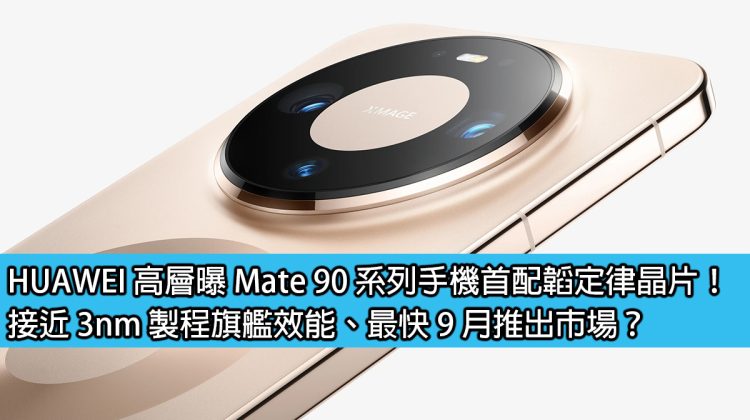
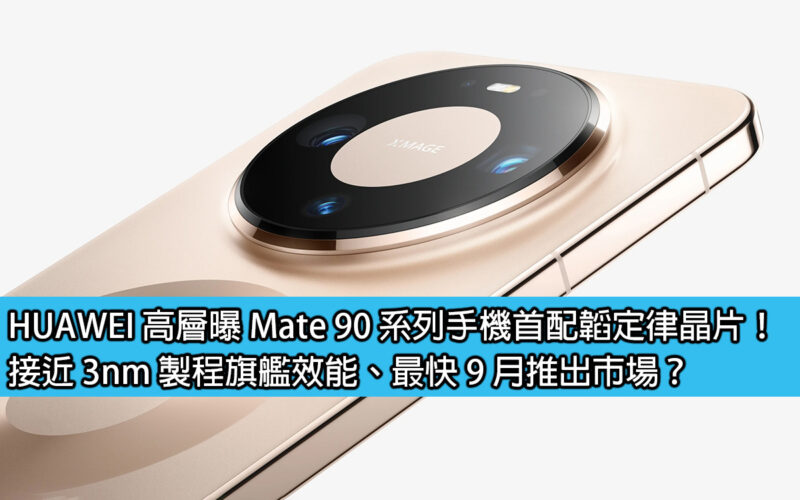
HUAWEI recently announced the Tao (τ) Law design paradigm, which uses logic stacking to design chips to achieve dramatic improvements in computing performance and power efficiency. Earlier, Zheng Jun, CTO of HUAWEI Financial Systems Department, stated that the Mate 90 series of mobile phones launched this year will be equipped with Taofu law chips for the first time.
Domestic media quoted Zheng Jun, CTO of Huawei’s Financial Systems Department, as saying that the Mate 90 series of mobile phones, which adopt Tao’s Law design paradigm chips, will be deployed for the first time in 2026 and are expected to appear as soon as September.
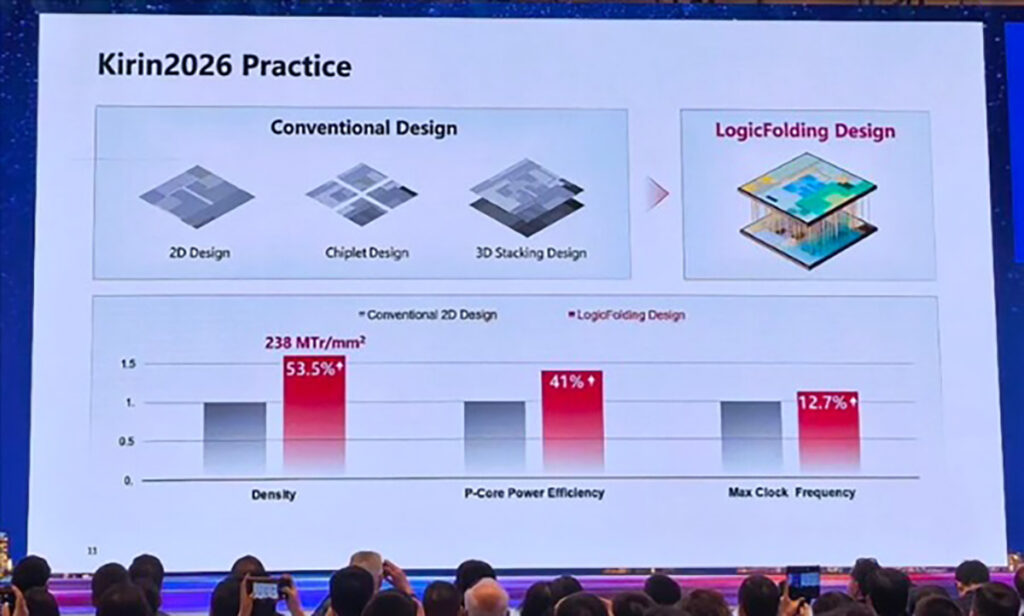
According to information released by HUAWEI, the chipset forms a core using a logic stacking method, which can achieve a transistor density of 238MTr/mm². It can theoretically reach the Intel 18A process level and is close to TSMC’s first-generation 3nm technology.
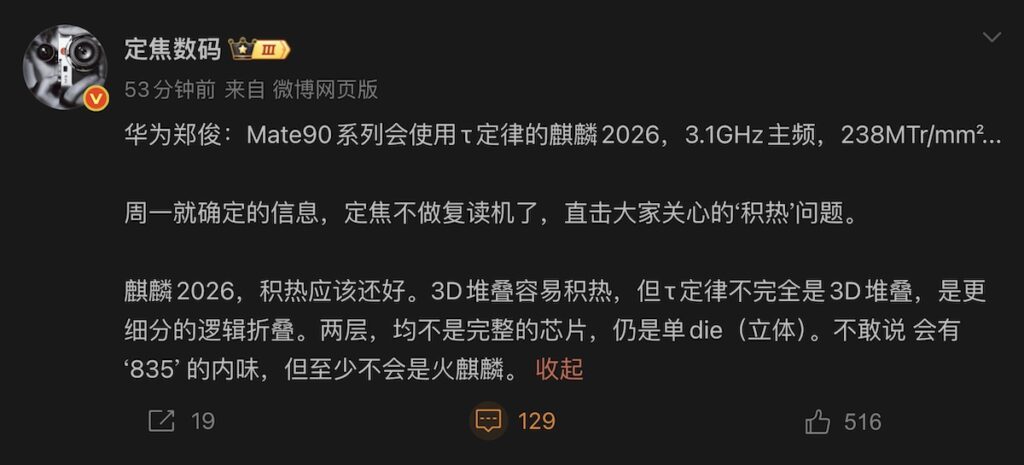
The Kirin chip designed by Tao Law has a power efficiency improvement of up to 41% and an operating clock speed of 12.7% compared to the original version. According to digital blogger “Fix Focus Digital”, the main core clock can reach 3.1GHz.
Mobile Magazine’s short comment: “Fixed focus digital” means that although the new chip uses stacking technology, it adopts a more advanced design that maintains a single Die (three-dimensional). It will still have good performance in heat control while improving performance.
Source: Kuai Technology, Weibo