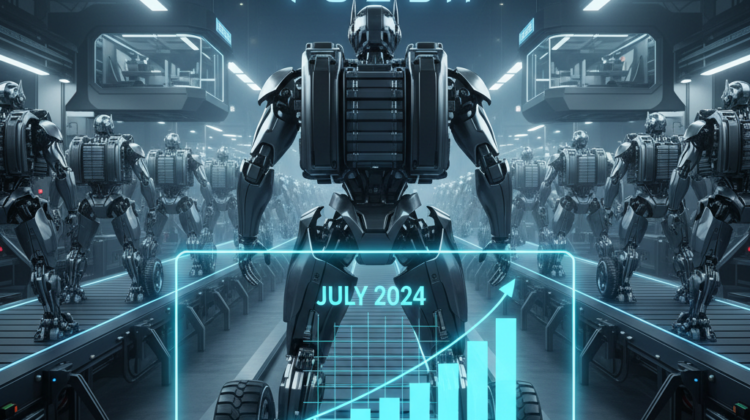
Late July or August isn’t just a production window for Tesla’s Optimus—it’s a signal about how Elon Musk is framing the timeline: not as a rapid leap to mass adoption, but as a controlled, manufacturing-first ramp where early output may be “quite slow.” In other words, the early story of Optimus won’t be about robots everywhere; it will be about how Tesla builds the factory discipline required to scale one.
When Musk declined to name a 2026 volume target, he effectively shifted the debate away from forecasting and toward capability. That choice matters because it suggests Tesla is optimizing for throughput learning—cycle time, uptime, maintenance patterns, and the reliability of repeatable tasks—before it dares the market with numbers that can be wrong in either direction. If the initial Fremont output is indeed slow, the real benchmark won’t be unit counts; it will be whether the deployment behaves like an industrial system rather than a research project.
From “former Model S/X line” to robot manufacturing: why Fremont’s location is the strategy
Tesla says Optimus production will begin at its Fremont site, specifically on the former Model S/X production line. That detail is more than reuse of real estate; it’s a manufacturing decision. The Model S/X line already represents a built-in engineering ecosystem—fixtures, material flow, and a workforce trained to hit industrial tolerances—even if the product changes from vehicles to robots.
The timeline “late July or August” implies Tesla is threading Optimus into a schedule that likely preserves existing operations while repurposing equipment. Turning an automotive line into a robotics production flow isn’t a simple swap of parts; it’s a redesign of how subassemblies move through stations, how quality is verified, and how labor or automation is assigned at each step. By choosing Fremont rather than a greenfield robotics plant, Tesla is betting that industrial execution speed beats novelty.
Commercial deployment in factories: the credibility test before mass production
Before production volume catches the market’s attention, Optimus has been described as moving into commercial deployments in select manufacturing plants. That sequencing—deploy first, scale later—is common in automation rollouts because it exposes failure modes that are invisible in demo environments: tool wear, unpredictable part variance, operator interaction, and downtime cascades.
The deployment narrative highlights repetitive assembly work and the ability to operate for extended hours. That matters because “extended hours” isn’t just a convenience metric—it’s a systems metric. If a robot can run longer between interruptions, then your effective throughput improves without adding headcount. For Tesla, where cost control and process discipline are central, extended operational windows can make the difference between a robot that looks impressive in a video and one that makes business sense on the factory floor.
Even so, the gap between “commercial deployment” and “high-volume production” is where most programs stumble. Early production at Fremont starting in late July or August suggests Tesla is moving from field validation toward standardized manufacturing. The question investors and operators should be asking is whether Tesla can convert real-world deployment lessons into a repeatable robot build—consistent joints, reliable actuators, stable calibration routines, and predictable end-effector performance.
Musk’s framing: calling Optimus Tesla’s biggest product ever while refusing volume promises
Musk’s language about Optimus—describing it as Tesla’s “greatest product in history” and the “biggest product ever”—isn’t just marketing. It’s an attempt to reset expectations: if Optimus succeeds, it won’t merely be another revenue line; it could become a platform for labor substitution across industries. But the refusal to provide a 2026 volume target is the counterweight: Tesla is not asking the market to believe in certainty yet.
The reported figure of a $25B investment plan adds another layer. Big numbers like that usually imply more than assembling robots—they point to supply chain depth, manufacturing tooling, and the infrastructure needed to reduce unit cost over time. If Optimus starts slow, that investment can be interpreted as Tesla buying down the risk of scaling: learning curves in manufacturing, improvement of components, and tightening of quality control so that failures don’t explode as output increases.
So the tension between “quite slow” early output and ambitious product framing may be intentional. It suggests Tesla wants to protect the narrative of industrial reliability. Robots that fail often don’t scale; robots that fail predictably, get serviced quickly, and keep working under factory constraints do.
What to watch next: the metrics that will reveal whether Optimus is truly scaling
If Tesla begins Optimus production at Fremont in late July or August, the most actionable question for the next several months is: what changes when the factory ramp begins? Investors and buyers should look for operational benchmarks such as uptime during repetitive tasks, mean time to repair, and how quickly robots can be redeployed after maintenance. These are the levers that determine whether a robot line can be cost-effective without constant supervision.
Second, watch how Tesla transitions from “select manufacturing facilities” deployment to broader rollout. A wider spread across plants will surface differences in parts tolerances, floor layout, safety procedures, and operator training. If Optimus performs consistently across that variation, it signals that Tesla has built robust capabilities rather than a narrow “perfect environment” demonstration.
Third, track the supply chain and component standardization implied by the $25B investment claim. The fastest path to scaling robotics usually comes from designing around repeatable parts and simplifying assembly rather than endlessly customizing. If Tesla’s robot production mirrors automotive’s discipline—high consistency, strong QA, and fast iteration—then the slow start in Fremont could be the front end of a rapid improvement curve.
Finally, the absence of a 2026 production volume target shouldn’t be taken as a lack of confidence. It may be Tesla’s way of saying: we’ll let manufacturing prove the pace. The more Tesla can demonstrate that early Optimus units are improving cycle time and reducing downtime week over week, the more credible the ramp becomes—regardless of whether Tesla announces a number.
Takeaway: Optimus isn’t being sold as fast—it’s being built as scalable
Optimus entering Fremont production in late July or August, on a former Model S/X line, reads like a manufacturing-first playbook. Coupled with earlier commercial deployments in select manufacturing plants, Tesla appears to be validating robots in real industrial conditions before betting heavily on scale.
The next phase will be defined less by grand product rhetoric and more by industrial metrics: reliability, uptime, serviceability, and repeatability of build quality. If Tesla can turn a “quite slow” early output into an accelerating ramp, Optimus may move from a compelling vision to a durable manufacturing platform—one that could eventually reshape labor-intensive processes across factories.