Every time a new iPhone is launched, a common topic “PWM dimming strobe” appears on the Internet. Some people find that watching the iPhone 13 screen for a long time will cause eye fatigue, dizziness and other uncomfortable phenomena. Is the PWM strobe to blame? ? what is the problem? This article will explain why the OLED screen uses PWM dimming, why the iPhone 13 screen will be fatigued and painful after viewing it for a long time, and how to solve and avoid the PWM stroboscopic problem. Let me tell you all at once.
Does iPhone 13 screen flicker hurt your eyes?
Does iPhone flicker hurt your eyes? In fact, there is no correct answer to this sentence, mainly because so far there is no correct clinical data to prove that stroboscopic can hurt the eyes, mainly because the current data are numbers measured by instruments, and everyone is sensitive to stroboscopic There will be different reactions to different degrees.
The human eye can see the screen flicker frequency below 100Hz, and cannot detect the higher frequency flicker, but some people’s eye perception is more sensitive, mainly because these people can perceive the flicker below 200Hz. For most People are unaware.
For more sensitive users, the strobe is invisible, but after a period of time, the screen will quickly turn on and off at a certain frequency after a certain period of time. After too much stimulation, it will cause visual fatigue, migraine, and irritability. Emotions and other conditions, if it goes down for a long time, will lead to deepening of myopia and deepening of astigmatism.
What is iPhone 13 strobe? What do DC dimming and PWM dimming mean?
Whether it is an iPhone or Android phone equipped with a screen, two types of strobes are now used, namely “DC dimming and PWM dimming”. Both types of strobes will appear. The indication is not obvious. Let me explain what DC is. Dimming, and what is PWM dimming:
What is DC dimming?
DC dimming is to change the brightness of the screen by increasing or reducing the power of the circuit. The screen will not produce stroboscopic phenomenon. At present, only the old LED screen models of Apple will use DC dimming, such as iPhone 11, iPhone XR, iPhone SE series and so on.
What is PWM dimming?
PWM dimming is to adjust the brightness of the screen by controlling the electric transistor of the screen to continuously switch and flicker. The brightness of the screen is adjusted by the brightness on time, which is the so-called duty cycle. The lower the relative screen brightness, the thicker the black bar will be, which will cause the frequency Flashing the user group, causing eye fatigue.
At present, most OLEDs use global PWM dimming, such as iPhone X, iPhone 11 Pro / Max, iPhone 12 series and iPhone 13 series models, and some use global PWM, or use global PWM and high-brightness DC , The latter is adjusted by the brightness value. When the screen is brighter, it will be controlled by DC-like, and the screen will be PWM if it is below a certain value. As for the global PWM dimming threshold, it is 100% brightness. When the screen brightness is lower, the fluctuation The depth will be greater.
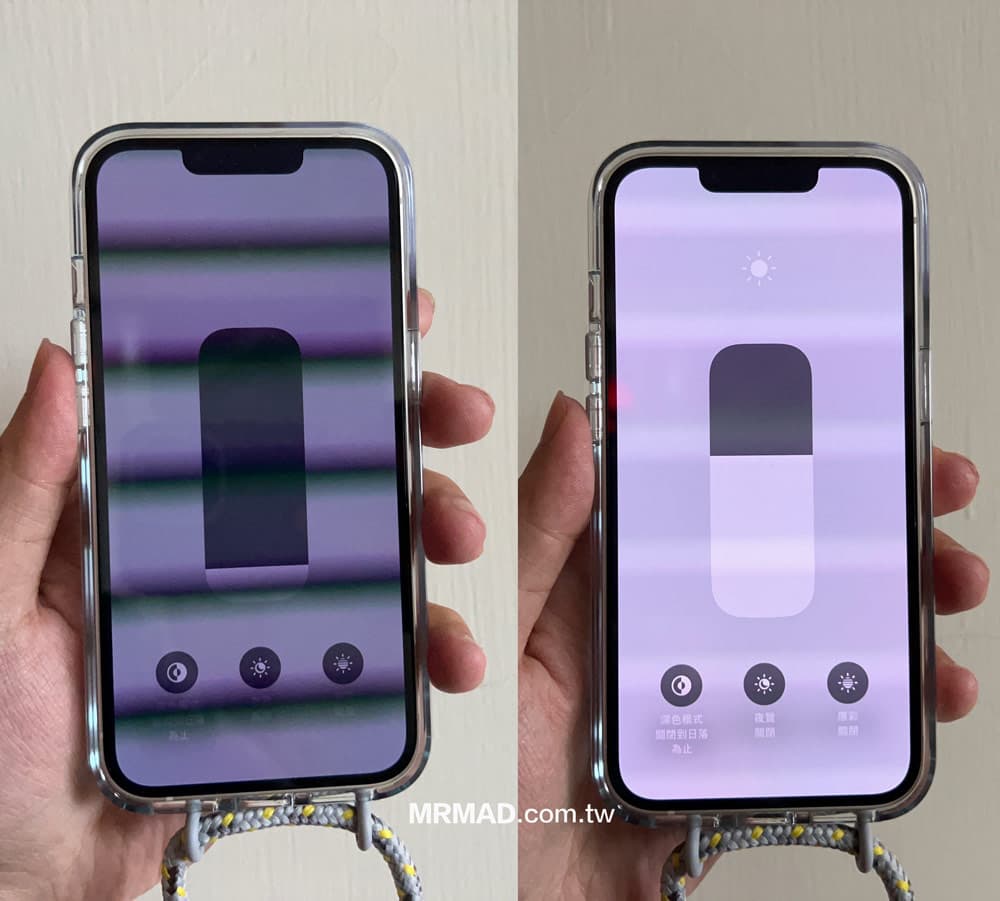
So what happens to PWM strobe? Next, use another iPhone to open the shutter to the highest point through the professional camera app to capture the iPhone 13 screen. You will find that the iPhone 13 screen uses global PWM dimming. Under a low-brightness screen, you will find that the screen is flashing line by line. Swipe down, this is why the camera will see this black bar running when shooting on the OLED screen. In fact, this is the normal phenomenon caused by the rapid flickering of the OLED. On the contrary, when the screen brightness is increased, the lines become less obvious. Actually, these The line is the so-called PWM strobe.
There should be a standard to determine whether OLED screens will cause harm to human eyes, right?
Someone would use IEEE’s “LED Light Source Strobe Risk Assessment Criteria” to determine. It should be noted that this criterion is tailored for indoor lighting source LED lamps and is not suitable for the stroboscopic risk basis of mobile phone OLED screens. The main reason is that LED lamps are in frequency When flashing, there are two kinds of instant flashes that are 100% full brightness or full black. At present, there are no evaluation criteria for the risk and hazard of mobile phone OLED light source stroboscopic flicker.
So the current flicker risk index below 1250Hz actually needs to consider three indicators “dimming frequency, fluctuation depth, flicker index”, but IEEE’s evaluation standard only includes fluctuation depth and does not include flicker index, so the criteria will not be included. Too accurate.
What is the difference between OLED strobe and LCD splash screen?
So everyone will be curious about the difference between OLED screen flicker and LCD screen flicker? You can understand by comparing the pictures below. The strobe on the left OLED screen is a way of refreshing the screen one by one, while the right LCD is the entire screen flickering quickly. Relatively, some people think that the LCD screen will be uncomfortable after viewing it for a long time, and vice versa. Some people will find that OLED strobe is also uncomfortable.
OLED strobe vs. LCD screen flicker pic.twitter.com/z3u1inGNwa
— Mr. Mad (@MrMadtw) November 5, 2021
Why is it easier to look at the screen of the iPhone 13 than on the iPhone 12?
Many netizens on the Internet have also responded that after switching to an iPhone 13, the screen is more likely to cause eye fatigue or soreness than the iPhone 12 or the old iPhone for a long time. Why? First understand the screen dimming frequency of two iPhone models:
- iPhone 13 Pro / Max to PWM dimming frequency is 480Hz
- The PWM dimming frequency of iPhone 12 Pro/Max is 240Hz
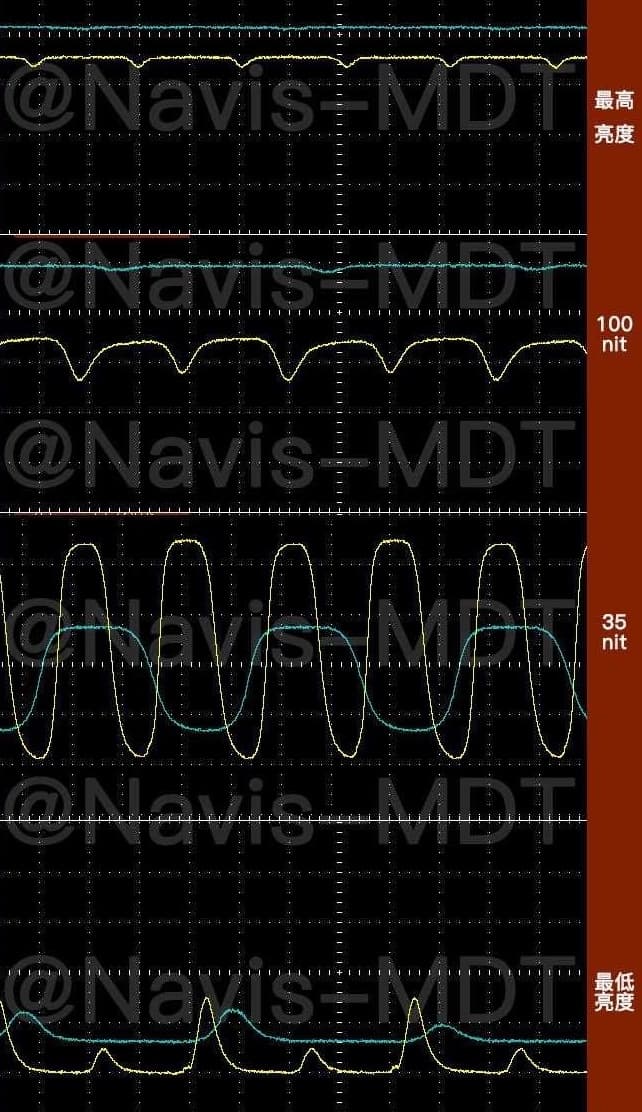
In principle, the higher the dimming frequency, the more comfortable the eyes will look, right? This was tested by Navis-MDT using professional instruments. At the same time, he also shared the comparison of the screen brightness waveforms of iPhone 13 Pro Max and iPhone 12 Pro Max. The results of each different brightness data are summarized as follows:
- High brightness: The “DC-like dimming” waveform of the iPhone 12 Pro Max is very stable, and the screen flickering is almost invisible. On the contrary, the iPhone 13 Pro Max uses global PWM dimming, with little fluctuation in the waveform, high duty cycle, and The flicker is small, and the stroboscopic problem can be basically ignored.
- 40% brightness: iPhone 12 Pro Max also relies on high-brightness DC dimming, the waveform is still stable, and you will not feel too obvious stroboscopic problems. On the contrary, iPhone 13 Pro Max starts to have obvious stroboscopic fluctuations.
- 19% brightness: iPhone 12 Pro Max switched from DC-like dimming mode to low-frequency PWM dimming 240Hz mode, the waveform also began to show obvious flicker; iPhone 13 Pro Max began to lose control, and severe flicker appeared early.
- Lowest brightness (under no light source environment): The iPhone 12 Pro Max’s waveform is actually smoother than that of the iPhone 13 Pro Max, and the iPhone 13 Pro Max starts to appear obvious momentary bumps, which also makes the screen flicker index more obvious changes.
From the above results, the PWM dimming of the iPhone 13 Pro Max is not as good as that of the iPhone 12 Pro Max. Instead, it is confirmed that the screen of the iPhone 13 Pro Max becomes darker in the dark environment.
So does it mean that DC-like dimming is better? In fact, it is not necessarily. No screen is perfect. For example, Redmi K40 can also turn on DC by setting, but it will cause the screen display effect to be slightly reduced, such as color cast, uneven brightness, noise, etc. It also made many manufacturers reluctant to add the DC-like dimming function in the end.
So does the LTPO screen of the iPhone 13 Pro / Max mean that the screen is poor? This conclusion is wrong. The main reason is that LTPO can support better dimming technology, so it can support DC dimming or high-frequency PWM dimming, but Samsung does not provide DC dimming technical support. You can guess why.
IPhone 13 flickering for a long time, my eyes will be sore. Why? Why am I not?
In fact, everyone’s sensitivity to iPhone strobe is completely different, which causes some users to feel very uncomfortable in their eyes after watching iPhone 13 for a period of time. On the contrary, most users do not have these problems. How to determine whether they are stroboscopic Flash sensitive user group? You can use the following methods to determine.
How to judge whether you are a stroboscopic sensitive user group
If you use a newly purchased iPhone or Android phone with an OLED screen, after a short period of time, the following symptoms will appear due to PWM dimming strobe, which can be judged as a “stroboscopic sensitive user group”:
- Eye fatigue and soreness
- Migraine
- Decreased vision loss
- Distracted easily
If the phone can still be returned, it is recommended to replace it during the appreciation period. After all, you can’t watch the OLED screen for a long time, which makes the eyes tired or sore after looking at it for a while, which is a very painful thing.
If you can’t feel the screen of the new iPhone at all, and if you use it for a long time, you won’t be tired. You don’t need to worry about the PWM stroboscopic problem. However, you must pay attention to moderately rest your eyes to effectively reduce the flash and myopia.
How to improve or reduce the stroboscopic problem?
If you like iPhone 13 and you can’t return it, is there a way to solve the problem of sore eyes? Perhaps it can be solved through the following methods:
How to improve strobe 1. The screen brightness should not be lower than 25%
At present, the iPhone 12 screen dimming method adopts the traditional Samsung OLED dimming mode. As long as the brightness is lower than 25%, it will automatically switch to 60H PWM dimming. If it is higher than 25%, it will be changed to DC-like dimming. Type, it is recommended that the screen brightness be higher than 25% to avoid stroboscopic flicker.
If it is the iPhone 13 screen, from the previous test data, the screen brightness must be adjusted to 40% or above to reduce the discomfort of stroboscopic flicker caused by PWM.
How to improve strobe 2. Don’t use your mobile phone under low light at night
iPhone users want to avoid the PWM stroboscopic problem, the fastest way is to not look at the iPhone screen in low light or completely dark environment, mainly use the phone in a dim and low light environment, the PWM dimming screen stroboscopic will be more intense, yes Eye irritation and damage will be higher than those in bright light environments.
Improve stroboscopic method 3. Turn on dark mode
The most obvious screen flicker is in the white screen. Another faster solution is to turn on the iPhone dark mode, which can also reduce brightness fluctuations, which has reduced the flicker problem. As for some people, it is possible to use “reduce the white point value” “It can be improved. In fact, this function has no effect at all in the PWM dimming mode.
How to improve strobe 4. Take a moderate rest
First of all, make sure that as soon as you pick up your phone to play, you just don’t have a break for several hours without interruption? If so, this is not a stroboscopic problem, but a visual fatigue and soreness caused by excessive eye use.
Human eyes will start to change with age and time. Before using the iPhone, I could not feel it. A few years later, I complained of symptoms when I switched to the iPhone. You should urge yourself. After using the phone for a while, you should let your eyes down. Suspending rest is the real solution.
Improve stroboscopic method 5. Change LCD model to solve
If you are more sensitive to the screen frequency, you can consider switching to top LCD screen models, such as iPhone 11, iPhone XR and other LCD screen models, which still use DC dimming screens.
However, it should be noted that the Harvard University Health Report has pointed out that the blue light value of the LCD screen will be high, and it will also cause eye damage in low light environment. It can cause insomnia or reduced sleep quality. You may consider sticking an anti-blue light protector.
However, OLED screens produce less blue light than LCDs, but they still have them. There are also reports confirming that using PWM dimming in low-light environments can cause eye pain or injury to some people.
Improve stroboscopic method 6. Choose high frequency PWM dimming screen
At present, the iPhone 13 series all use PWM dimming frequency of 480Hz, such as Android phones such as Huawei P50, Honor and other mobile phones, adopting BOE screens also have PWM dimming frequency screens greater than 1440Hz.
Of course, this is not to promote the replacement of Android phones, but to see if Apple can increase the PWM frequency for the iPhone screen in the future. It is recommended that the first two points can be used to achieve real improvements.
Improve the strobe method 7. Choose the built-in DC dimming of the OLED screen
At present, some Android models will add the “global anti-flicker” or “DC dimming” switch function when using the OLED screen. However, the current iPhone does not have this function to adjust, so it can be ignored.
Summary: iPhone 13 Pro series strobe is particularly serious?
After reading the above description, finally, give three conclusions for the iPhone 13 stroboscopic problem:
- The iPhone 13 Pro series strobe is indeed worse than the iPhone 12 Pro series
- iPhone 13 Pro series strobe is not particularly serious
- Through the method in this article, you can avoid the stroboscopic problem
Some people have been directly holding the iPhone 13 stroboscopic problem to death on the Internet, and it will cause panic and attention, but in fact, it also came out with Navis-MDT to refute the rumors. The iPhone 13 stroboscopic on the Internet is not special. Seriously, it’s just being over-interpreted. There are still ways to improve the OLED strobe method.