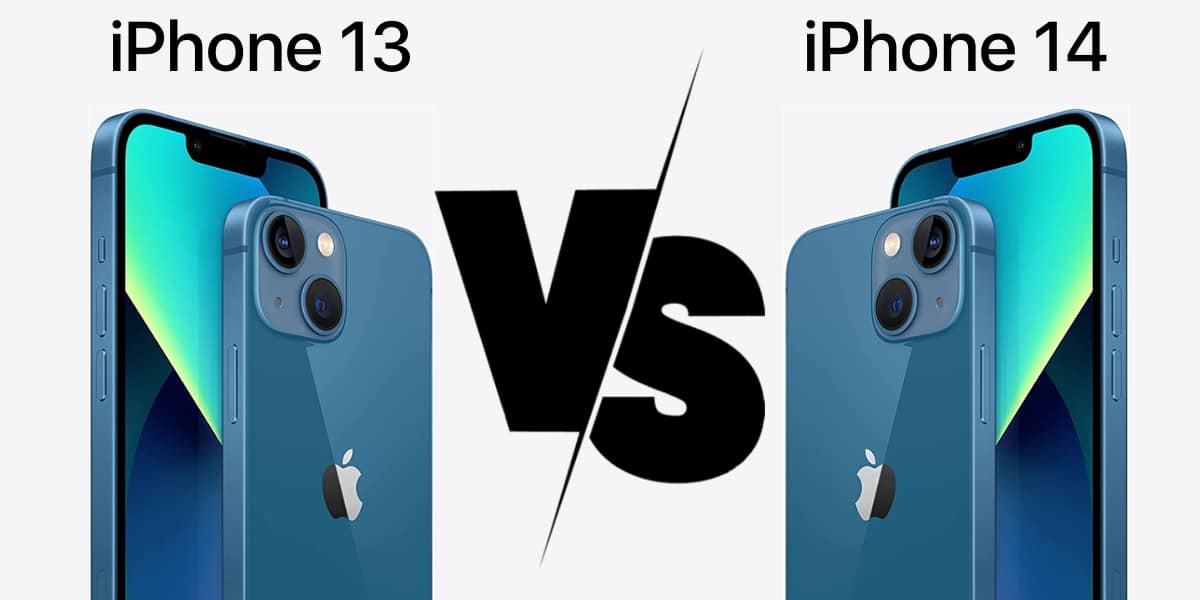
As usual, the launch of a new iPhone isn’t immune to controversy, backtracking, and of course comparisons, lots of comparisons. Every iPhone’s successor of the year has been called upon to make significant improvements, however, everyone loves rain, and this iPhone 14 is surrounded by a halo of complaints from users who clearly need more news.
We put the iPhone 13 and iPhone 14 head-to-head to see if it’s really worth switching devices. There’s more news behind the new iPhone 14 than you might think, but…are they enough?
Design: Reasonable Similarities
Let’s start by focusing on the design. The external dimensions and weight are practically the same, that is, the iPhone 13 measures 14,67 × 7,15 × 0,76 cm, while the iPhone 14 measures 14,67 × 7,15 × 0,78 cm. The weight has barely changed, at 13 grams for the iPhone 173 and 14 grams for the iPhone 172, and despite the new features introduced, it’s slimmer, curious.
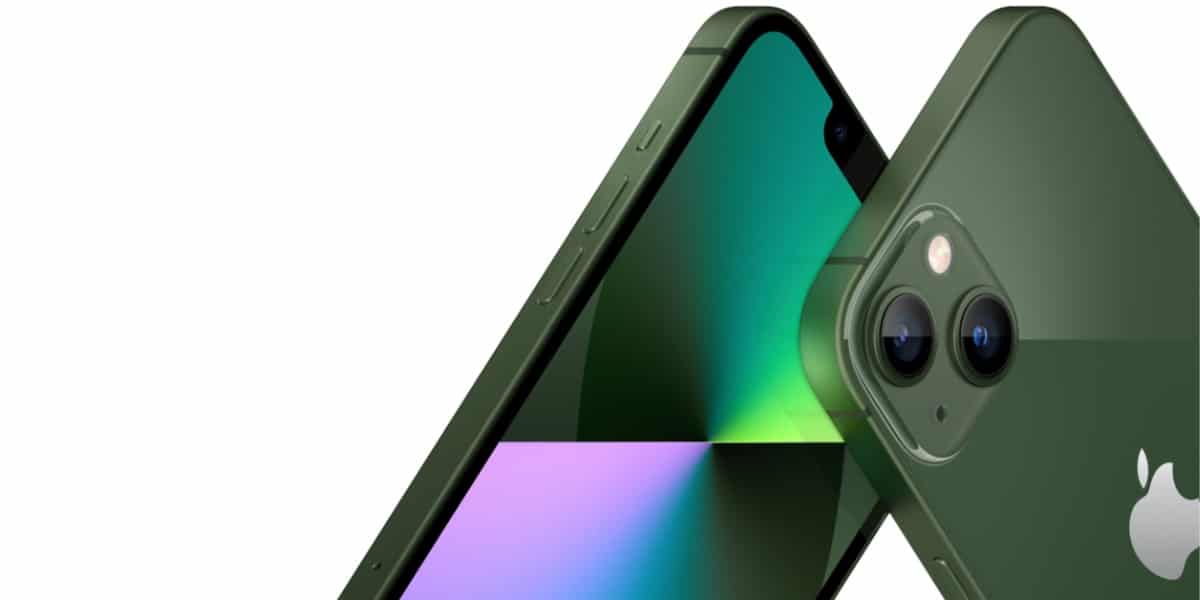
In fact, it is practically impossible to distinguish between the camera modules at a glance, considering that not only the layout but also the size of the camera modules are preserved. They’re so similar that the case used for the iPhone 13 is fully compatible with the iPhone 14, which apparently doesn’t happen with the “Pro” model due to the size of the camera module.
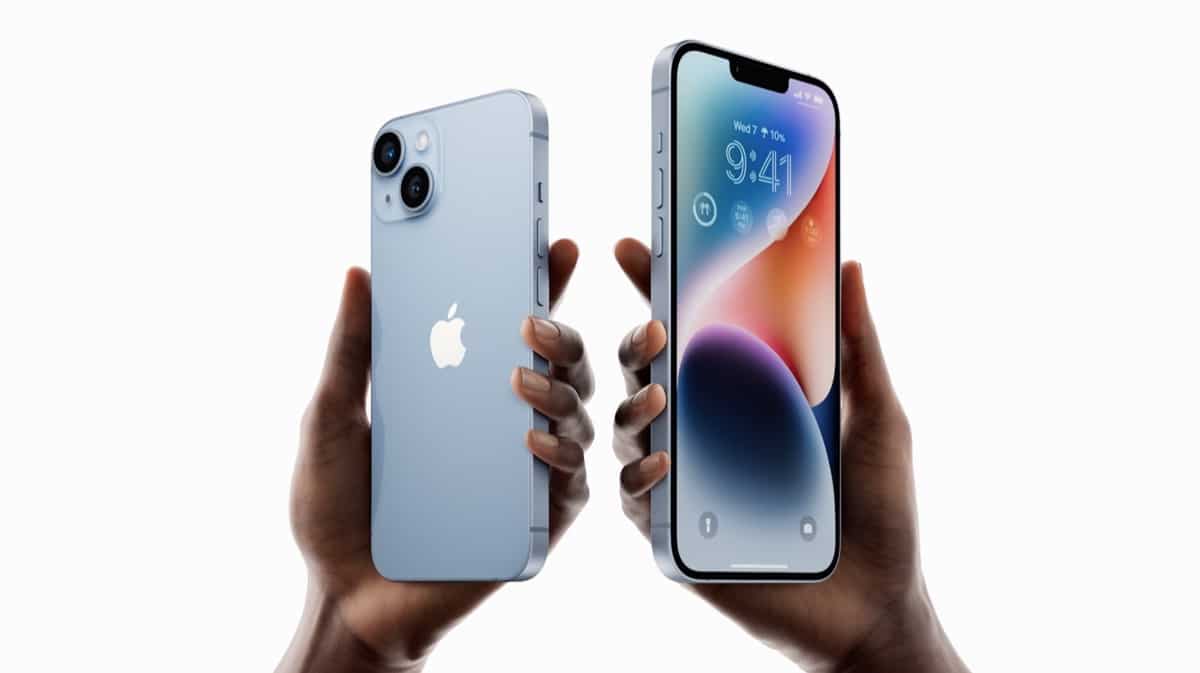
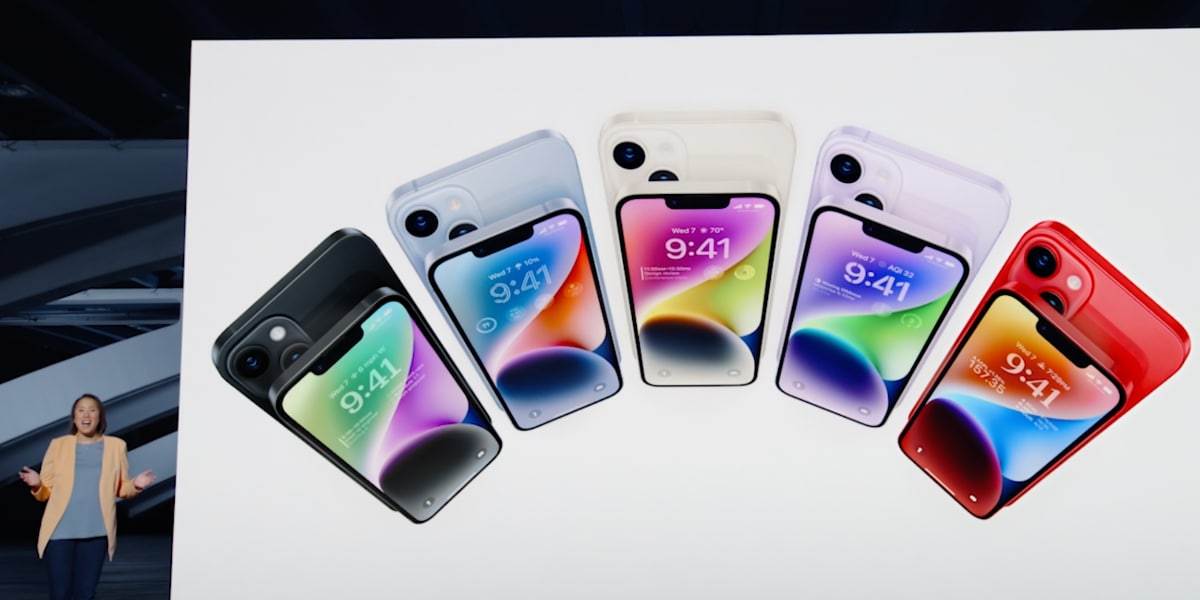
The chassis of both devices is made of aluminum and the back is made of glass, allowing for MagSafe wireless charging. As for the color range, the iPhone 14 is available in white, black, blue, purple and red. For its part, the iPhone 13 is also available in green, with slightly different shades of some colors.
The resistance level is the same, with an IP68 rating, allowing immersion for 30 minutes to a depth of 6 meters, accompanied by a ceramic shielding glass that guarantees maximum strength and durability on the smartphone screen.
The iPhone 13 and iPhone 14 have the same location for the buttons, speaker, microphone, camera, and Lightning port. On the front, we find a panel of exactly the same size with the same notch. It can be said that the changes at the aesthetic level are completely imperceptible.
Multimedia: They are twins
Both devices maintain the same quality standards on the screen, as well as proportions and dimensions. They ride on a 6,1-inch Super Retina XDR OLED panel that supports Dolby Vision HDR technology.
- 6,1 inches, 15,4 cm diagonal
- 2.532 x 1.170 pixels resolution, 460 pixels per inch
In this way, they maintain a maximum brightness of 800 nits typical, with an HDR peak of 1.200 nits, down from the 14 nits offered by the iPhone 2.000 Pro. We have wide color gamut (P3), ambient True Tone technology, haptic response via software, and an oleophobic housing.
As we said, all these features and functions of the screen are the same in both devices, which is to say, Apple has not invested in improving this part of the standard version of the iPhone at all.
Camera: “Big” Jump
Very similar features on paper. We started with the iPhone 13 which installed a 12 Mpx main camera with f/1.6 aperture and optical image stabilization via sensor displacement, optical zoom x2 and digital zoom up to x4. As far as the secondary camera goes, the 12 Mpx ultra-wide offers an f/2.4 aperture.
On the other hand, we have the iPhone 14, with a 12 Mpx camera system, only this time the main variant of the model offers an f/1.5 focal aperture, while keeping the rest of the parameters indifferent.
However, at the software level, the iPhone 14 uses the Photonic Engine system to improve photo quality even in low light.
As for video recording, both the iPhone 14 and iPhone 13 have the recording feature. 4K up to 60 FPS, 1080p slo-mo up to 240FPS and stereo recording, and the only difference is that in this case, in addition to Movie mode, the iPhone 14 software supports Action Mode for more stable footage in repetitive motion situations.
Finally there is the front camera, while the iPhone 13 installs a 2.2 Mpx sensor with f/12 focal length, the iPhone 14 offers the same 12 Mpx but is compatible with the Photonic Engine system and f/1.9 focal length, allows recording cinema mode up to 4K HDR 30FPS, Keep the iPhone 13 at 30p at 1080FPS.
Hardware and Connectivity: A Little More
Apple has decided to use the iPhone 13 Pro’s A14 Bionic processor in the iPhone 15, but considering the two offer a total of six cores, two performance cores, and four efficiency cores, the only change we understand is that the iPhone 14 has 5 cores GPU, while the iPhone 13’s GPU remains “only” 4 cores.
Both use a 16-core Neural Engine system, while the iPhone 14 has 6GB of RAM (like the iPhone 13 Pro), and the iPhone 13 retains 4GB of RAM.
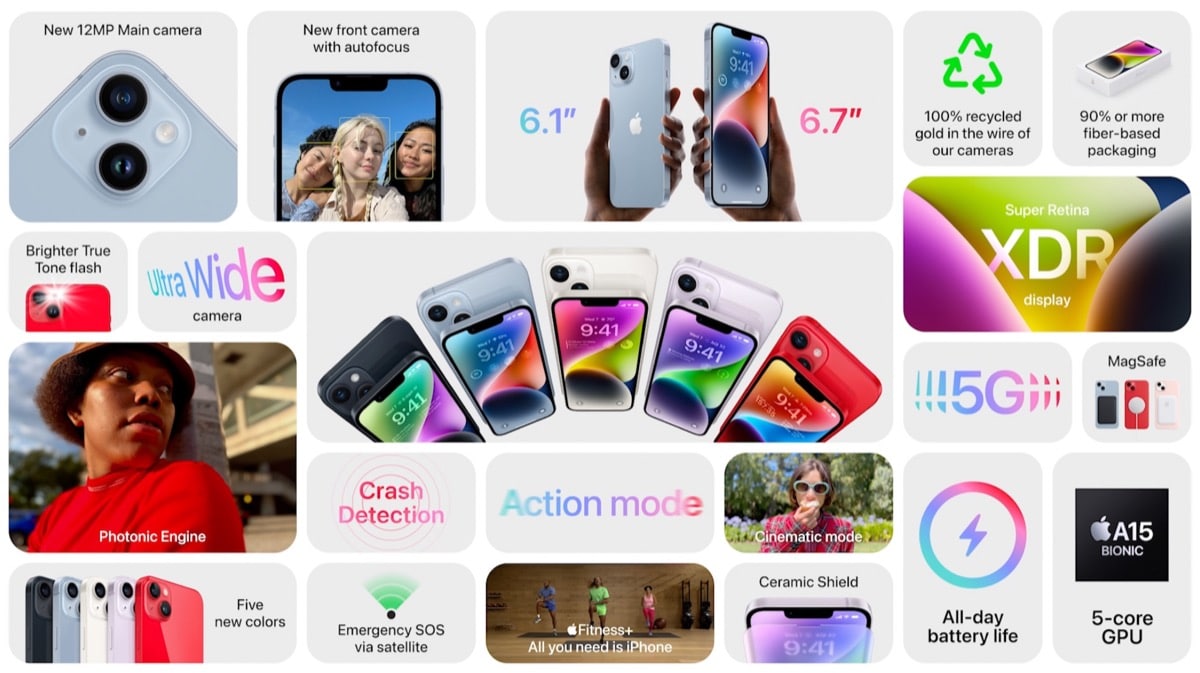
Regarding safety issues, the iPhone 14 implements an accident detection system, a software solution not included in the iPhone 13. Curious, yes, while the iPhone 14 implements a satellite connection system for emergencies, it lacks CDMA EV-DO connectivity, which is present in the iPhone 13, GPS, WiFi 6, and retains Bluetooth functionality, which is in the iPhone 13’s In the current case, it will be Bluetooth 5.0, and in the iPhone 14, it will be a leap forward with Bluetooth 5.3. Obviously, both devices are compatible with 5G networks.
Keeping the Qi-standard MagSafe wireless charging system, both devices are limited to a maximum of 20W per cable. According to Apple, the iPhone 14’s total autonomy will increase by about an hour, although the change will likely be imperceptible.
The most important thing is the price
It’s time to remember that the 13GB base model of the iPhone 128 starts at 909 euros, that is, it maintains its official launch price. For its part, the starting model of the iPhone 14, the 128GB model, starts at 1.009 euros, which means an increase of at least 100 euros, keeping 128GB, 256GB and 512GB of storage depending on our needs.
Now it’s up to you to decide if it’s really worth the extra 20 euros because of the news and the fact that it’s impossible to distinguish one model from another, what do you think?