Apple is selling two MacBook Pros at once this fall. The Liquid Retina XDR models that arrived in March keep a Mini-LED backlight. The new PROLED XDR models switch to tandem OLED with touch built into the panel. MacRumors lined the two up on October 29, and the short version is this: the chips do not change, and PROLED costs $400 more.
Same M5 Pro and M5 Max chips, $400 apart
The 14-inch MacBook Pro with M5 Pro starts at $2,499 with Liquid Retina XDR and $2,899 with PROLED XDR. The 16-inch M5 Pro models are $2,999 and $3,399. MacRumors says the $400 gap holds across the sizes and chip tiers it compared. Apple's Newsroom announcement puts the 14-inch M5 Max PROLED at $4,499.
Chip options and memory capacities are the same on both sides, up to 128GB of unified memory on the Max configurations per Apple. Battery-life claims do not move either. The 14-inch PROLED carries a slightly larger 72.6Wh battery against 72.4Wh, and Apple's endurance figures stay the same. Nothing in this purchase is faster. It is only about the screen, the touch layer, and the weight. Our launch report from October 29 has Apple's full spec sheet, and Gurman's pre-launch pricing note, reported here on October 28, turned out to be exactly right.
Tandem OLED versus Mini-LED on the spec sheet
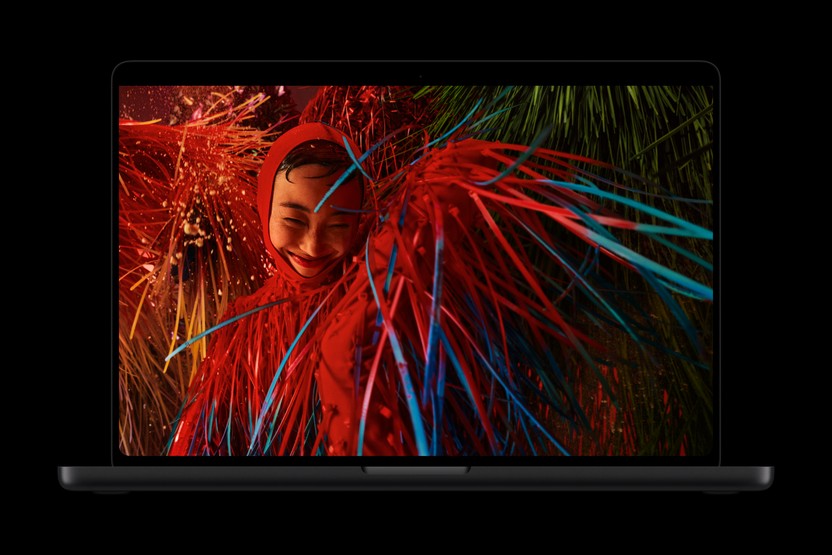
Liquid Retina XDR is a Mini-LED-backlit LCD with local dimming, rated at 1,000,000:1 contrast and up to 1,600 nits peak HDR. PROLED XDR is two self-illuminating OLED pixel layers, rated at 10,000,000:1 and up to 2,000 nits peak HDR. Both sustain 1,000 nits of full-screen HDR, so the extra nits are a peak figure, not a constant one.
Color is the other panel difference. PROLED covers P3 and Adobe RGB and adds reference modes for Adobe RGB-D50 print work and Adobe RGB-D65 photography. Both panels keep a 1-nit minimum brightness, True Tone, one billion colors, and 254 pixels per inch. The 14-inch resolution shifts slightly, from 3024 by 1964 to 3024 by 1986. The 16-inch goes from a 16.2-inch panel at 3456 by 2234 to 16.3 inches at 3472 by 2266. The camera notch becomes a smaller Dynamic Island cutout with slimmer borders.
Touch input, Dynamic Island, and a 13.8 percent weight drop
The Multi-Touch sensor sits directly in the display panel instead of layered on top, which Apple says reduces latency and bulk. macOS translates taps into clicks for existing applications, and adds gestures like double-tap to fill a window and flick to tile it. The hinge is redesigned for stability during touchscreen use, and the 12MP Center Stage camera gains video stabilization to reduce shake while you touch the screen.
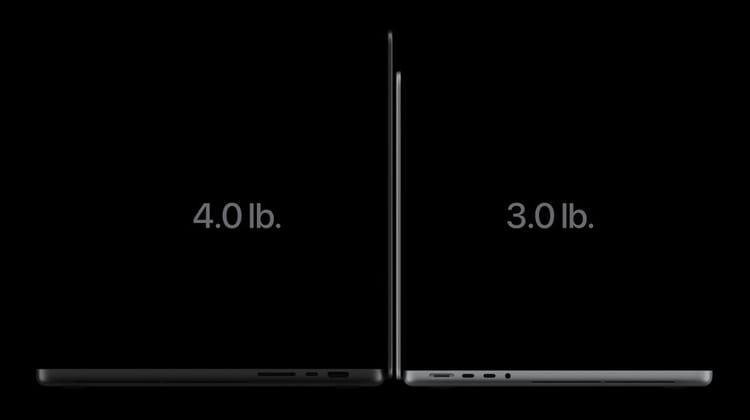
Weight is where the redesign shows most. The 14-inch M5 Pro falls from 1.60 kg to 1.38 kg, down 13.8 percent. The 16-inch M5 Pro drops from 2.14 kg to 1.82 kg, down 15.0 percent. Thickness moves less, from 1.55 cm to 1.50 cm on the 14-inch. Apple also rerouted cooling to push warm air away from the display and lit up the rear Apple logo. Our October 28 pre-order checklist covers the rest of the ordering details.

Storage, genlock, and who should pay the $400
Two more PROLED-only items. M5 Max storage now goes to 16TB, where the Liquid Retina XDR models stop at 8TB, and genlock synchronizes display refresh rate with camera capture for video work. External 4K display support rises from 144Hz to 165Hz on the listed arrangements. One quirk: the 16-inch M5 Max PROLED lists a 94W minimum recommended charger against 70W on the Mini-LED model.
Who should pay it. If the MacBook Pro sits on a desk driving an external reference monitor, the Liquid Retina XDR model is the same computer for $400 less. If the laptop screen is the main display, and you do Adobe RGB print and photo work or touch the panel every day, PROLED is the one to order before the November 6 ship date.
Photo: Apple Newsroom. Source: MacRumors, Apple Newsroom