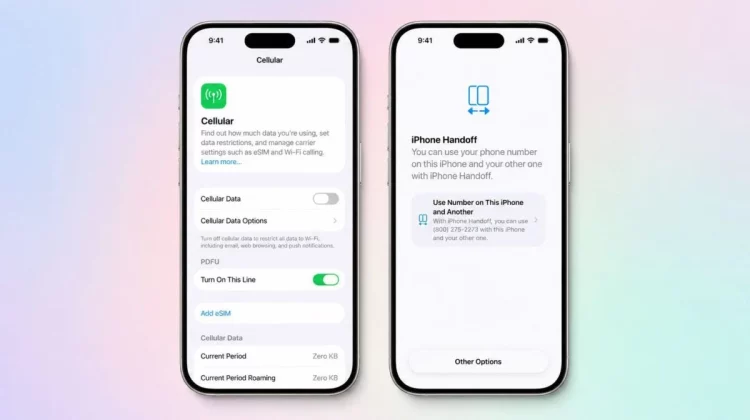
Apple will introduce “iPhone Handoff” as a new feature in iOS27. Until now, in principle, one phone number was tied to one iPhone (or SIM), but with this function, it will be possible to share and switch the exact same phone number between two iPhones.
We previously reported that a new feature has been discovered that allows two iPhones to use the same number.In this article, we will summarize the basic specifications and usage conditions that were announced, as well as analyze and discuss “why this technology was realized,” “the impact on the Japanese market,” and “pitfalls in the domestic environment such as Suica and LINE.”
Overview of “iPhone Handoff” and consideration of its technical mechanism
iPhone Handoff combines eSIM technology with Apple’s cloud infrastructure to seamlessly share one phone number between two iPhones.
Basic operating specifications
iPhone Handoff offers the convenience of automatically switching devices depending on the situation without requiring the user to be aware of any special operations, and provides clear division of roles. The main operating specifications are the following two points.
Automatic switching (seamless transition)
The phone number will be automatically activated on the iPhone whose screen is unlocked. “You have switched to this iPhone” will be displayed on the screen, and you will be able to use calls, SMS/MMS, mobile data communication, tethering, etc. as is.
Please note that the phone number is always activated on only one iPhone, and cannot be activated on two iPhones at the same time.
Relationship between main machine and sub machine
During setup, one device is defined as the “main iPhone” and the other as the “sub iPhone.” Some carrier services, such as call forwarding, caller ID, and account management, can only be set up from your primary iPhone.
Technical background and security mechanism
The core of this function is presumed to be a structure in which an eSIM profile linked to the same telephone number identifier (MSISDN) is deployed to two devices, and the unlocking of the device (biometric authentication) is used as a trigger to rewrite the location registration information (register) on the network side.
In addition, the reason why Wi-Fi connection, sign-in with the same Apple account, and iCloud communication are required as usage conditions is thought to be because it functions as a double authentication mechanism to prevent unauthorized device switching (such as SIM swap fraud) via Apple’s servers, rather than relying solely on the control of the carrier network.
Required conditions and operating environment for use
To use iPhone Handoff, you need to have the following environment in place.
- iOS27 or later must be installed on both devices.
- Be signed in with the same Apple Account
- Be connected to Wi-Fi
- FaceTime and iMessage must be turned on
- “Keep messages in iCloud” is turned on
Regarding operation in dual SIM environment
If either SIM is from a carrier that supports iPhone Handoff, it can be used as a dual SIM. In this case, unlocking the device will switch both SIMs at the same time.
Compatible carriers and impact/price prediction on the Japanese market
To use iPhone Handoff, it is essential that the communication carrier’s system is supported.
Telecommunications carriers scheduled to be supported
- Early launch:
- T-Mobile (USA)
- Deutsche Telekom (Germany)
- Scheduled to be supported sequentially:
- Verizon (USA)
- EE (UK)
Examples of monthly charges and forecast for domestic expansion
T-Mobile charges a monthly add-on fee of $5 (approximately 750 yen) to use this feature.
For deployment in the Japanese market, each carrier (NTT Docomo, au, Softbank, Rakuten Mobile) will need to upgrade their subscriber management database (HLR/HSS).
Number sharing for Apple Watch is already well established in Japan, but new system investment is required in terms of communication traffic control to support dynamic switching between iPhones.
Considering the “$5 per month” setting in the United States and the market price of shared services for Apple Watch in Japan (385 yen to 550 yen per month), we predict that if it is introduced in Japan, it will likely be provided as a paid option for around 550 yen to 880 yen per month (tax included).
Three points to note and pitfalls in usage scenarios unique to Japan
Although this is a very convenient feature at first glance, there are some functional limitations and specifications that need to be noted in the Japanese user environment.
Transportation IC (Suica/PASMO/ICOCA) wall
Due to Apple Pay specifications, a transit card can only exist on one device at a time. Even if your phone number is automatically transferred using iPhone Handoff, Suica and other items in your wallet will not be automatically transferred, so if you go out with just the sub-device, you will end up in a situation where you can connect to the phone but cannot pass through the ticket gate.
Commuter pass users will need to replace their card every time they move their device.
“One number, one device” restriction for major domestic apps such as LINE
LINE, which is an essential infrastructure in Japan, can only authenticate one smartphone per phone number for security reasons. Please note that even if calls and SMS reception are moved to the sub-device by switching numbers, LINE chat history and accounts will not be automatically transferred between the two devices.
Separation of Apple Watch cooperation
This function does not include the function to automatically follow and switch the pairing destination of Apple Watch. Even if you switch to a lightweight sub-device and go out on holiday, the Apple Watch will try to maintain the connection with the main device, so unless you manually re-pair it, there will be a lag in the reception of healthcare data and notifications.
Should I introduce iPhone Handoff?
Based on the specifications and verification thus far, we have determined which users should take advantage of this feature and which users should be put off.
I want to use my old iPhone for outdoor activities and sports.
Recommended level: ★★★★★
Switching to a sub-machine in situations where the risk of damage or loss is high is extremely effective. This helps protect the main machine.
Using the folding iPhone Duo with existing devices
Recommended level: ★★★★☆
Ideal for heavy users who want to switch between the newly designed iPhone Duo and the previous Pro model depending on their needs.
I want to separate work and private calls
Recommended level: ★★☆☆☆
Because the system shares the same phone number, it is not suitable for separating public and private matters. It is better to have a separate number with dual SIM.
I want to completely synchronize Suica and LINE between two devices.
Recommended level: ★☆☆☆☆
Please note that due to specification limitations on the app side, there is a high possibility that you will not be able to get the “completely seamless experience” you expect.
The key to true value in Japan is “compromise between carriers and apps”
iOS27’s “iPhone Handoff” is a revolutionary feature that makes it smart to switch between multiple devices.
However, in order for Japanese users to fully benefit from this, the key points going forward will be not just OS compatibility, but also “compatibility with domestic carrier infrastructure” and “following the specifications of major domestic apps such as Suica and LINE.”
Photo: MacRumors
Source: iPhone Mania