John Ternus, Apple’s senior vice president of hardware engineering, officially took over as Apple’s CEO on September 1, and Apple officially entered a new management stage.
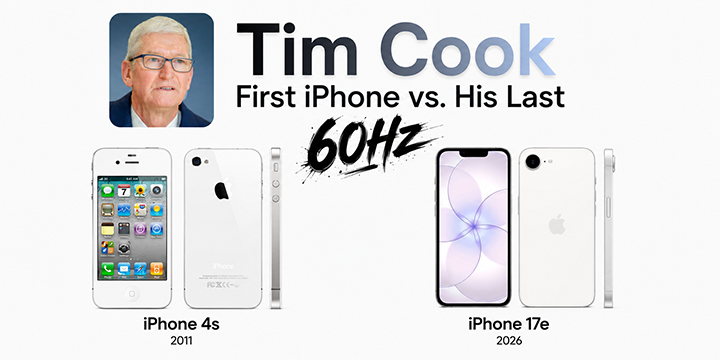
Some netizens noticed that when Cook was the CEO of Apple, the first mobile phone released during his tenure was the iPhone 4s, and the last mobile phone was the iPhone 17e. Interestingly, both models were equipped with 60Hz refresh rate screens, and there was a full 15 years between them.
Since the iPhone 13 Pro series first introduced ProMotion’s automatic adaptive refresh frequency technology, high refresh rate screens have gone through nearly five years of development in the Apple camp. However, to this day, Apple’s e-series product line, whether it is iPhone 16e or iPhone 17e, still sticks to 60Hz screens.
Apple’s strategic intention is very clear, which is to use the screen refresh rate to draw a clear line of product levels. The e-series maintains performance competitiveness by installing flagship A-series chips, while making trade-offs in screen specifications to control overall costs. This combination of “flagship chips with low refresh rate screens” essentially allows users to pay for performance, but compromises on daily use experience.
However, the market structure of the Android camp has long changed. 120Hz high refresh rate screens have almost become standard configurations. The sliding smoothness and touch feel brought by high refresh rates often improve the experience in daily use, which is often more intuitive and obvious than simply upgrading processor performance.
It is worth noting that the iPhone 18e, which will be launched in the first half of next year, is rumored to still maintain a 60Hz update rate. If this news is true, then the e-series products will be equipped with 60Hz screens for three consecutive generations, and have never been able to keep up with the mainstream of the industry in terms of update rate, a core experience indicator.
Although the computing performance of the A-series chips is still superior to similar products, due to the limitation of the screen refresh rate, the daily sliding and visual interaction experience is still greatly reduced, resulting in a sense of “excessive performance and weaknesses in the experience”.